
$A$ radioactive material $P$ first decays into $Q$ and then $Q$ decays to non-radioactive material $R$. Which of the following figures represents the time-dependent mass of $P$,$Q$,and $R$?
- A
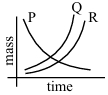
- B
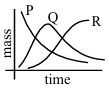
- C
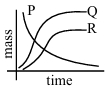
- D
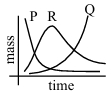
Explore More
Similar Questions
In $\beta^{-}$ decay, a neutron transforms into a proton within the nucleus according to the equation:
$\text{neutron} \rightarrow \text{proton} + \beta^{-} + x$
In this equation, the particle represented by '$x$' is:
$\text{neutron} \rightarrow \text{proton} + \beta^{-} + x$
In this equation, the particle represented by '$x$' is:
Before the neutrino hypothesis,the beta decay process was thought to be the transition $n \to p + e^-$. If this were true,show that if the neutron was at rest,the proton and electron would emerge with fixed energies and calculate them. Experimentally,the electron energy was found to have a large range.
Difficult
View SolutionOriginally, radioactive beta decay was thought to be a decay of a nucleus with the emission of electrons only (Case $I$). However, in addition to the electron, another (nearly) massless and electrically neutral particle is also emitted (Case $II$). Based on the figure below, which of the following is correct?
Beta rays emitted by a radioactive material are
Easy
View Solution$A$ nucleus $_n{X^m}$ emits one $\alpha$ and one $\beta$ particle. The resulting nucleus is:
Vedclass Products
For Students
Vedclass Test Series
Mock tests in real JEE/NEET style with performance analysis. 5-day free trial.
Start Free TrialFor Teachers
Exam Paper Generator
Generate Set A/B/C/D exam papers from 7.5L+ questions in 2 minutes. 3 chapters free.
Try FreeFor Institutes
Online Exam Module
Live online exams with unlimited students, 360° analytics & white-label branding.
See Demo