
For a pure substance, if $T_B$ is the melting point and $T_A$ is the freezing point, which graph correctly represents the relationship between the change in entropy $(\Delta S)$ and temperature $(T)$?
- A
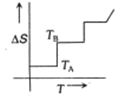
- B
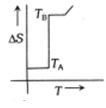
- C
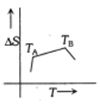
- D
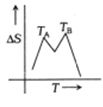
Explore More
Similar Questions
One mole of a monatomic ideal gas undergoes four thermodynamic processes as shown schematically in the $PV$-diagram below. Among these four processes,one is isobaric,one is isochoric,one is isothermal and one is adiabatic. Match the processes mentioned in List-$I$ with the corresponding statements in List-$II$.
List-$I$ List-$II$ $P$. In process $I$ $1$. Work done by the gas is zero $Q$. In process $II$ $2$. Temperature of the gas remains unchanged $R$. In process $III$ $3$. No heat is exchanged between the gas and its surroundings $S$. In process $IV$ $4$. Work done by the gas is $6 P_0 V_0$
| List-$I$ | List-$II$ |
| $P$. In process $I$ | $1$. Work done by the gas is zero |
| $Q$. In process $II$ | $2$. Temperature of the gas remains unchanged |
| $R$. In process $III$ | $3$. No heat is exchanged between the gas and its surroundings |
| $S$. In process $IV$ | $4$. Work done by the gas is $6 P_0 V_0$ |
MediumIIT 2018
View SolutionThe entropy versus temperature plot for phases $\alpha$ and $\beta$ at $1 \ bar$ pressure is given. $S_T$ and $S_0$ are entropies of the phases at temperatures $T$ and $0 \ K$,respectively.
The transition temperature for $\alpha$ to $\beta$ phase change is $600 \ K$ and $C_{p, \beta} - C_{p, \alpha} = 1 \ J \ mol^{-1} \ K^{-1}$. Assume $(C_{p, \beta} - C_{p, \alpha})$ is independent of temperature in the range of $200$ to $700 \ K$. $C_{p, \alpha}$ and $C_{p, \beta}$ are heat capacities of $\alpha$ and $\beta$ phases,respectively.
$(1)$ The value of entropy change,$S_{\beta} - S_{\alpha}$ (in $J \ mol^{-1} \ K^{-1}$),at $300 \ K$ is. . . . . . .
$(2)$ The value of enthalpy change,$H_{\beta} - H_{\alpha}$ (in $J \ mol^{-1}$),at $300 \ K$ is.
[Use : $\ln 2 = 0.69$,Given : $S_{\beta} - S_{\alpha} = 0$ at $0 \ K$]
The transition temperature for $\alpha$ to $\beta$ phase change is $600 \ K$ and $C_{p, \beta} - C_{p, \alpha} = 1 \ J \ mol^{-1} \ K^{-1}$. Assume $(C_{p, \beta} - C_{p, \alpha})$ is independent of temperature in the range of $200$ to $700 \ K$. $C_{p, \alpha}$ and $C_{p, \beta}$ are heat capacities of $\alpha$ and $\beta$ phases,respectively.
$(1)$ The value of entropy change,$S_{\beta} - S_{\alpha}$ (in $J \ mol^{-1} \ K^{-1}$),at $300 \ K$ is. . . . . . .
$(2)$ The value of enthalpy change,$H_{\beta} - H_{\alpha}$ (in $J \ mol^{-1}$),at $300 \ K$ is.
[Use : $\ln 2 = 0.69$,Given : $S_{\beta} - S_{\alpha} = 0$ at $0 \ K$]
For the reaction,$2 CO + O_2 \longrightarrow 2 CO_2$; $\Delta H = -560 \ kJ$. Two moles of $CO$ and one mole of $O_2$ are taken in a container of volume $1 \ L$. They completely form two moles of $CO_2$. The gases deviate appreciably from ideal behavior. If the pressure in the vessel changes from $70 \ atm$ to $40 \ atm$,find the magnitude (absolute value) of $\Delta U$ at $500 \ K$. $(1 \ L \ atm = 0.1 \ kJ)$
For the reaction of one mole of zinc dust with one mole of sulphuric acid in a bomb calorimeter,$\Delta U$ and $w$ correspond to
MediumAIIMS 2005
View SolutionCalculate the enthalpy change when $50 \ mL$ of $0.01 \ M$ $Ca(OH)_2$ reacts with $25 \ mL$ of $0.01 \ M$ $HCl$. Given that $\Delta H^o$ for neutralization of a strong acid and a strong base is $-13.7 \ kcal \ mol^{-1}$. (Note: The provided value in the prompt $140 \ kcal \ mol^{-1}$ is physically incorrect for neutralization; using standard value $-13.7 \ kcal \ mol^{-1}$ for calculation). (in $kcal$)
Difficult
View SolutionVedclass Products
For Students
Vedclass Test Series
Mock tests in real JEE/NEET style with performance analysis. 5-day free trial.
Start Free TrialFor Teachers
Exam Paper Generator
Generate Set A/B/C/D exam papers from 7.5L+ questions in 2 minutes. 3 chapters free.
Try FreeFor Institutes
Online Exam Module
Live online exams with unlimited students, 360° analytics & white-label branding.
See Demo