
Three positive charges $q$ are placed at the vertices of an equilateral triangle. How do their electric field lines appear?
- A
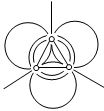
- B
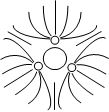
- C
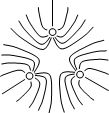
- D
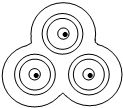
Explore More
Similar Questions
$A$ charge $Q$ is uniformly distributed over the volume of an insulating sphere of radius $R$. $A$ thin metal shell of radius $b$ $(b > R)$ with a charge $-Q$ is placed around the sphere. The space between the sphere and the shell is filled with air. Which of the following graphs correctly represents the electric field $E$ as a function of distance $r$ from the center?
Medium
View SolutionThe figure represents a crystal unit of cesium chloride, $CsCl$. The cesium atoms, represented by open circles, are situated at the corners of a cube of side $0.40 \, nm$, whereas a $Cl$ atom is situated at the centre of the cube. The $Cs$ atoms are deficient in one electron while the $Cl$ atom carries an excess electron.
$(i)$ What is the net electric field on the $Cl$ atom due to eight $Cs$ atoms?
$(ii)$ Suppose that the $Cs$ atom at the corner $A$ is missing. What is the net force now on the $Cl$ atom due to the seven remaining $Cs$ atoms?
$(i)$ What is the net electric field on the $Cl$ atom due to eight $Cs$ atoms?
$(ii)$ Suppose that the $Cs$ atom at the corner $A$ is missing. What is the net force now on the $Cl$ atom due to the seven remaining $Cs$ atoms?
Medium
View Solution$A$ point charge $q$ moves from point $P$ to $S$ along the path $PQRS$ in a uniform electric field $E$ directed parallel to the positive $X$-axis. The coordinates of points $P, Q, R,$ and $S$ are $(a, b, 0), (2a, 0, 0), (a, -b, 0),$ and $(0, 0, 0)$ respectively. Calculate the work done by the electric field in this process.
Difficult
View SolutionTwo identical point charges are placed at a separation of $l$. $P$ is a point on the line joining the charges,at a distance $x$ from any one charge. The field at $P$ is $E$. $E$ is plotted against $x$ for values of $x$ from close to zero to slightly less than $l$. Which of the following best represents the resulting curve?
Difficult
View SolutionIn a regular polygon of $10$ sides,each corner is at a distance $R$ from the centre. Identical charges $q$ are placed at $9$ corners. At the centre,the magnitude of the electric field is $E$ and the potential is $V$. The ratio $\frac{V}{E}$ is
Vedclass Products
For Students
Vedclass Test Series
Mock tests in real JEE/NEET style with performance analysis. 5-day free trial.
Start Free TrialFor Teachers
Exam Paper Generator
Generate Set A/B/C/D exam papers from 7.5L+ questions in 2 minutes. 3 chapters free.
Try FreeFor Institutes
Online Exam Module
Live online exams with unlimited students, 360° analytics & white-label branding.
See Demo