
Class 11PhysicsNewton's Laws of Motion and FrictionMix Examples-Newton's Laws of Motion and Friction
Difficult$A$ man can move on a horizontal plank supported symmetrically as shown. The variation of normal reaction on support $A$ with distance $x$ of the man from the end of the plank is best represented by:
- A
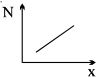
- B
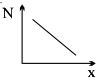
- C
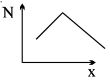
- D
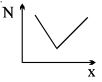
Explore More
Similar Questions
$Assertion$: Two bodies of masses $M$ and $m$ $(M > m)$ are allowed to fall from the same height. If the air resistance for each is the same,then both bodies will reach the Earth simultaneously.
$Reason$: For the same air resistance,the acceleration of both bodies will be the same.
$Reason$: For the same air resistance,the acceleration of both bodies will be the same.
$A$ body of mass $2 \ kg$ is acted upon by two forces each of magnitude $1 \ N$ and inclined at $60^{\circ}$ with each other. The acceleration of the body in $m/s^2$ is $[\cos 60^{\circ}=0.5]$
Three forces acting on a body are shown in the figure. To have the resultant force only along the $y-$ direction,the magnitude of the minimum additional force needed is ........... $N$.
MediumAIPMT 2008
View Solution$A$ body is imparted motion from rest to move in a straight line. If it is then obstructed by an opposite force,then:
Easy
View SolutionState whether the following statements are true or false:
$(a)$ Momentum and the change in momentum are always in the same direction.
$(b)$ Action force and reaction force always act simultaneously and on the same body.
$(c)$ The maximum static frictional force depends on the area of the contact surface.
$(a)$ Momentum and the change in momentum are always in the same direction.
$(b)$ Action force and reaction force always act simultaneously and on the same body.
$(c)$ The maximum static frictional force depends on the area of the contact surface.
Medium
View SolutionVedclass Products
For Students
Vedclass Test Series
Mock tests in real JEE/NEET style with performance analysis. 5-day free trial.
Start Free TrialFor Teachers
Exam Paper Generator
Generate Set A/B/C/D exam papers from 7.5L+ questions in 2 minutes. 3 chapters free.
Try FreeFor Institutes
Online Exam Module
Live online exams with unlimited students, 360° analytics & white-label branding.
See Demo