
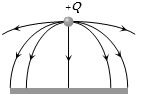
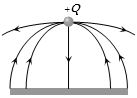
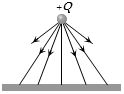
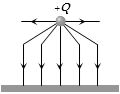
$A$ charge $Q$ is fixed at a distance $d$ in front of an infinite metal plate. The lines of force are represented by
- A
- B
- C
- D
Explore More
Similar Questions
$A$ cube of side $b$ has a charge $q$ at each of its vertices. The electric field due to this charge distribution at the centre of this cube will be
Easy
View SolutionThis question contains Statement-$1$ and Statement-$2$. Of the four choices given after the statements,choose the one that best describes the two statements.
Statement-$1$ : For a charged particle moving from point $P$ to point $Q$,the net work done by an electrostatic field on the particle is independent of the path connecting point $P$ to point $Q$.
Statement-$2$ : The net work done by a conservative force on an object moving along a closed loop is zero.
MediumAIEEE 2009
View SolutionThree point charges are placed at the corners of an equilateral triangle. Assuming only electrostatic forces are acting, which of the following statements is true?
Easy
View SolutionTwo equal negative charges $-q$ are placed at points $(0, a)$ and $(0, -a)$ on the $Y$-axis. A positive charge $q$ is released from rest at point $(2a, 0)$. What will be the motion of this charge?
Easy
View Solution$A$ point charge $q$ moves from point $P$ to $S$ along the path $PQRS$ in a uniform electric field $E$ directed parallel to the positive $X$-axis. The coordinates of points $P, Q, R,$ and $S$ are $(a, b, 0), (2a, 0, 0), (a, -b, 0),$ and $(0, 0, 0)$ respectively. Calculate the work done by the electric field in this process.
Difficult
View SolutionVedclass Products
For Students
Vedclass Test Series
Mock tests in real JEE/NEET style with performance analysis. 5-day free trial.
Start Free TrialFor Teachers
Exam Paper Generator
Generate Set A/B/C/D exam papers from 7.5L+ questions in 2 minutes. 3 chapters free.
Try FreeFor Institutes
Online Exam Module
Live online exams with unlimited students, 360° analytics & white-label branding.
See Demo