
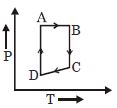
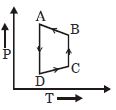
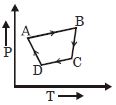
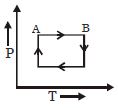
$A$ cyclic process $ABCD$ is shown in the given $P-V$ diagram. The $P-T$ diagram that represents the same process is
- A
- B
- C
- D
Explore More
Similar Questions
Five moles of an ideal gas has pressure $p_0$, volume $V_0$, and temperature $T_0$. The gas is expanded to volume $3V_0$ along a path such that the pressure $p$ changes as a function of volume $V$ as $p = p_0(V/V_0)$. The pressure is then reduced to $p_0$ while maintaining constant volume. Finally, the gas undergoes an isobaric compression until the volume and temperature return to $V_0$ and $T_0$, respectively. The total work done by the gas during the entire process is:
When $80 \ J$ of heat is supplied to a gas at constant pressure,if the work done by the gas is $20 \ J$,then the ratio of the specific heat capacities of the gas is
$A$ monatomic gas of volume $V$ and pressure $P$ expands isothermally to a volume $27 V$ and then is compressed adiabatically to a volume $V$. The final pressure of the gas is: (in $P$)
DifficultAP EAMCET 2023
View SolutionWhen an ideal gas is heated at constant pressure,what percentage of the heat supplied is used to perform external work? $(\gamma = 5/3)$
Medium
View SolutionAn ideal gas,initially in state $(P_{12}, V_1, T_1)$ is expanded isobarically to $(P_{12}, V_2, T_2)$,then adiabatically to $(P_{34}, V_3, T_3)$. It is then contracted isobarically to $(P_{34}, V_4, T_4)$ and finally adiabatically back to the initial state. The efficiency of this cycle is
Vedclass Products
For Students
Vedclass Test Series
Mock tests in real JEE/NEET style with performance analysis. 5-day free trial.
Start Free TrialFor Teachers
Exam Paper Generator
Generate Set A/B/C/D exam papers from 7.5L+ questions in 2 minutes. 3 chapters free.
Try FreeFor Institutes
Online Exam Module
Live online exams with unlimited students, 360° analytics & white-label branding.
See Demo