
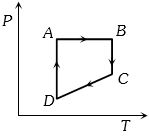
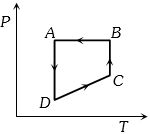
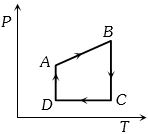
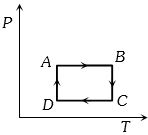
$A$ cyclic process $ABCD$ is shown in the $P-V$ diagram. Which of the following curves represent the same process?
- A
- B
- C
- D
Explore More
Similar Questions
One mole of an ideal gas undergoes two different cyclic processes $I$ and $II$,as shown in the $P-V$ diagrams below. In cycle $I$,processes $a, b, c$ and $d$ are isobaric,isothermal,isobaric and isochoric,respectively. In cycle $II$,processes $a^{\prime}, b^{\prime}, c^{\prime}$ and $d^{\prime}$ are isothermal,isochoric,isobaric and isochoric,respectively. The total work done during cycle $I$ is $W_I$ and that during cycle $II$ is $W_{II}$. The ratio $W_I / W_{II}$ is . . . .
Answer the following questions based on the $P-T$ phase diagram of $CO_{2}$:
$(a)$ $CO_{2}$ at $1 \; atm$ pressure and temperature $-60^{\circ} C$ is compressed isothermally. Does it go through a liquid phase?
$(b)$ What happens when $CO_{2}$ at $4 \; atm$ pressure is cooled from room temperature at constant pressure?
$(c)$ Describe qualitatively the changes in a given mass of solid $CO_{2}$ at $10 \; atm$ pressure and temperature $-65^{\circ} C$ as it is heated up to room temperature at constant pressure.
$(d)$ $CO_{2}$ is heated to a temperature $70^{\circ} C$ and compressed isothermally. What changes in its properties do you expect to observe?
$(a)$ $CO_{2}$ at $1 \; atm$ pressure and temperature $-60^{\circ} C$ is compressed isothermally. Does it go through a liquid phase?
$(b)$ What happens when $CO_{2}$ at $4 \; atm$ pressure is cooled from room temperature at constant pressure?
$(c)$ Describe qualitatively the changes in a given mass of solid $CO_{2}$ at $10 \; atm$ pressure and temperature $-65^{\circ} C$ as it is heated up to room temperature at constant pressure.
$(d)$ $CO_{2}$ is heated to a temperature $70^{\circ} C$ and compressed isothermally. What changes in its properties do you expect to observe?
Medium
View SolutionAn ideal gas expands isothermally from volume $V_1$ to volume $V_2$. It is then compressed to the original volume $V_1$ adiabatically. If $p_1$ and $p_2$ represent the initial pressure and final pressure respectively, and $W$ represents the net work done by the gas during the entire process, then:
Two moles of a triatomic gas $\left(\gamma = \frac{4}{3}\right)$ at temperature $327^{\circ} C$ expands adiabatically such that its volume becomes $8$ times its initial volume. Later, the temperature of the gas is doubled in an isochoric process. The total work done in the two processes is ($R$ - universal gas constant). (in $R$)
Three moles of an ideal gas $\left( {{C_P} = \frac{7}{2}R} \right)$ at pressure ${P_A}$ and temperature ${T_A}$ is isothermally expanded to twice its initial volume. It is then compressed at constant pressure to its original volume. Finally, the gas is compressed at constant volume to its original pressure ${P_A}.$ The correct $P-V$ and $P-T$ diagrams indicating the process are
Medium
View SolutionVedclass Products
For Students
Vedclass Test Series
Mock tests in real JEE/NEET style with performance analysis. 5-day free trial.
Start Free TrialFor Teachers
Exam Paper Generator
Generate Set A/B/C/D exam papers from 7.5L+ questions in 2 minutes. 3 chapters free.
Try FreeFor Institutes
Online Exam Module
Live online exams with unlimited students, 360° analytics & white-label branding.
See Demo