
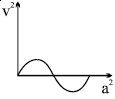
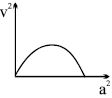
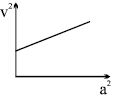
$A$ graph of the square of the velocity against the square of the acceleration of a given simple harmonic motion is
- A
- B
- C
- D
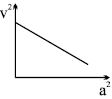
Explore More
Similar Questions
Two masses $m$ and $\frac{m}{2}$ are connected at the two ends of a massless rigid rod of length $l$. The rod is suspended by a thin wire of torsional constant $k$ at the centre of mass of the rod-mass system (see figure). Because of the torsional constant $k$,the restoring torque is $\tau = k\theta$ for an angular displacement $\theta$. If the rod is rotated by $\theta_0$ and released,the tension in it when it passes through its mean position will be
DifficultJEE MAIN 2019
View Solution$A$ person normally weighing $50\, kg$ stands on a massless platform which oscillates up and down harmonically at a frequency of $2.0\, s^{-1}$ and an amplitude $5.0\, cm$. $A$ weighing machine on the platform gives the person's weight against time.
$(a)$ Will there be any change in the weight of the body during the oscillation?
$(b)$ If the answer to part $(a)$ is yes,what will be the maximum and minimum reading on the machine and at which positions?
$(a)$ Will there be any change in the weight of the body during the oscillation?
$(b)$ If the answer to part $(a)$ is yes,what will be the maximum and minimum reading on the machine and at which positions?
Medium
View SolutionColumn $I$ gives a list of possible sets of parameters measured in some experiments. The variations of the parameters in the form of graphs are shown in Column $II$. Match the set of parameters given in Column $I$ with the graph given in Column $II$.
Column $I$ Column $II$ $(A)$ Potential energy of a simple pendulum ($y$-axis) as a function of displacement ($x$-axis) $(p)$ Parabolic curve opening upwards $(B)$ Displacement ($y$-axis) as a function of time ($x$-axis) for a one-dimensional motion at zero or constant acceleration $(q)$ Linear graph passing through origin $(C)$ Range of a projectile ($y$-axis) as a function of its velocity ($x$-axis) when projected at a fixed angle $(r)$ Linear graph with non-zero intercept $(D)$ The square of the time period ($y$-axis) of a simple pendulum as a function of its length ($x$-axis) $(s)$ Parabolic curve opening upwards (starting from origin)
| Column $I$ | Column $II$ |
|---|---|
| $(A)$ Potential energy of a simple pendulum ($y$-axis) as a function of displacement ($x$-axis) | $(p)$ Parabolic curve opening upwards |
| $(B)$ Displacement ($y$-axis) as a function of time ($x$-axis) for a one-dimensional motion at zero or constant acceleration | $(q)$ Linear graph passing through origin |
| $(C)$ Range of a projectile ($y$-axis) as a function of its velocity ($x$-axis) when projected at a fixed angle | $(r)$ Linear graph with non-zero intercept |
| $(D)$ The square of the time period ($y$-axis) of a simple pendulum as a function of its length ($x$-axis) | $(s)$ Parabolic curve opening upwards (starting from origin) |
$A$ particle is executing $SHM$ with an amplitude $A$ and angular frequency $\omega$. The ratio of the maximum acceleration to the maximum velocity of the particle is:
Medium
View SolutionThe displacement-time graph of a particle executing $SHM$ is shown. Which of the following statements is/are true?
Vedclass Products
For Students
Vedclass Test Series
Mock tests in real JEE/NEET style with performance analysis. 5-day free trial.
Start Free TrialFor Teachers
Exam Paper Generator
Generate Set A/B/C/D exam papers from 7.5L+ questions in 2 minutes. 3 chapters free.
Try FreeFor Institutes
Online Exam Module
Live online exams with unlimited students, 360° analytics & white-label branding.
See Demo