
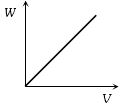
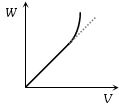
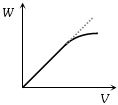
$A$ particle,initially at rest on a frictionless horizontal surface,is acted upon by a horizontal force which is constant in size and direction. $A$ graph is plotted between the work done $(W)$ on the particle and the speed of the particle $(v)$. If there are no other horizontal forces acting on the particle,the graph would look like:
- A
- B
- C
- D
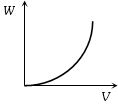
Explore More
Similar Questions
$A$ body of mass $m$ is travelling with a velocity $u$. When a constant retarding force $F$ is applied,it comes to rest after travelling a distance $s_{1}$. If the initial velocity is $2u$,with the same force $F$,the distance travelled before it comes to rest is $s_{2}$. Then,
DifficultKCET 2012
View Solution$A$ uniform chain of mass $M$ and length $L$ is released from rest from a smooth horizontal surface as shown in the figure. The velocity of the chain at the instant it completely comes off the table will be:
Medium
View SolutionState and establish the principle of conservation of mechanical energy.
Medium
View Solution$A$ mass of $2 \ kg$, initially at a height of $1.2 \ m$ above an uncompressed spring with spring constant $2 \times 10^4 \ N/m$, is released from rest to fall on the spring. Taking the acceleration due to gravity as $10 \ m/s^2$ and neglecting air resistance, the compression of the spring in $mm$ is:
DifficultTS EAMCET 2019
View Solution$A$ light rod of length $L$ is pivoted at its upper end. Two masses (each of mass $m$) are attached to the rod,one at its midpoint and the other at its free end. What horizontal velocity must be imparted to the lower end so that the rod reaches the horizontal position?
Medium
View SolutionVedclass Products
For Students
Vedclass Test Series
Mock tests in real JEE/NEET style with performance analysis. 5-day free trial.
Start Free TrialFor Teachers
Exam Paper Generator
Generate Set A/B/C/D exam papers from 7.5L+ questions in 2 minutes. 3 chapters free.
Try FreeFor Institutes
Online Exam Module
Live online exams with unlimited students, 360° analytics & white-label branding.
See Demo