
$A$ particle of mass $m$ is constrained to move on the $x$-axis. $A$ force $F$ acts on the particle. $F$ always points toward the position labeled $E$. For example,when the particle is to the left of $E$,$F$ points to the right. The magnitude of $F$ is constant except at point $E$ where it is zero. The system is horizontal. $F$ is the net force acting on the particle. The particle is displaced a distance $A$ towards the left from the equilibrium position $E$ and released from rest at $t=0$. The velocity-time graph of the particle is:
- A
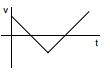
- B
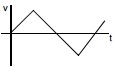
- C
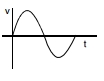
- D

Explore More
Similar Questions
The velocity $v$ of a particle is given by the equation $v = 6t^2 - 6t^3$,where $v$ is in $m/s$ and $t$ is time in $s$. Then:
Medium
View SolutionThe figure shows the displacement of a particle moving along the $X-$axis as a function of time. The force acting on the particle is zero in the region:
Medium
View SolutionThe maximum possible acceleration of a train moving on a straight track is $10\ m/s^2$ and the maximum possible retardation is $5\ m/s^2$. If the maximum achievable speed of the train is $10\ m/s$,then the minimum time in which the train can complete a journey of $135\ m$ starting from rest and ending at rest is.........$s$.
Medium
View SolutionThe $x-t$ graph of a particle moving along a straight line is shown in the figure. The $a-t$ graph of the particle is correctly shown by:
Difficult
View SolutionFor the velocity-time graph shown in the figure,what fraction of the total distance covered in all seven seconds is the distance covered by the body in the last two seconds of its motion?
Medium
View SolutionVedclass Products
For Students
Vedclass Test Series
Mock tests in real JEE/NEET style with performance analysis. 5-day free trial.
Start Free TrialFor Teachers
Exam Paper Generator
Generate Set A/B/C/D exam papers from 7.5L+ questions in 2 minutes. 3 chapters free.
Try FreeFor Institutes
Online Exam Module
Live online exams with unlimited students, 360° analytics & white-label branding.
See Demo