
Difficult
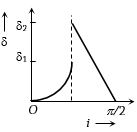
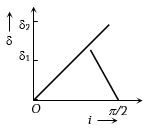
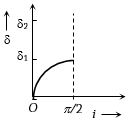
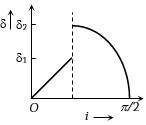
$A$ ray of light travels from a medium of refractive index $\mu$ to air. Its angle of incidence in the medium is $i$,measured from the normal to the boundary,and its angle of deviation is $\delta$. If $\delta$ is plotted against $i$,which of the following best represents the resulting curve?
- A
- B
- C
- D
Explore More
Similar Questions
Light guidance in an optical fiber can be understood by considering a structure comprising of a thin solid glass cylinder of refractive index $n_1$ surrounded by a medium of lower refractive index $n_2$. The light guidance in the structure takes place due to successive total internal reflections at the interface of the media $n_1$ and $n_2$. All rays with the angle of incidence $i$ less than a particular value $i_m$ are confined in the medium of refractive index $n_1$. The numerical aperture $(NA)$ of the structure is defined as $\sin i_m$.
$1.$ For two structures namely $S_1$ with $n_1=\sqrt{45}/4$ and $n_2=3/2$,and $S_2$ with $n_1=8/5$ and $n_2=7/5$,and taking the refractive index of water to be $4/3$ and that of air to be $1$,the correct option$(s)$ is(are):
$(A)$ $NA$ of $S_1$ immersed in water is the same as that of $S_2$ immersed in a liquid of refractive index $\frac{16}{3\sqrt{15}}$
$(B)$ $NA$ of $S_1$ immersed in a liquid of refractive index $\frac{6}{\sqrt{15}}$ is the same as that of $S_2$ immersed in water
$(C)$ $NA$ of $S_1$ placed in air is the same as that of $S_2$ immersed in a liquid of refractive index $\frac{4}{\sqrt{15}}$
$(D)$ $NA$ of $S_1$ placed in air is the same as that of $S_2$ placed in water
$2.$ If two structures of the same cross-sectional area,but different numerical apertures $NA_1$ and $NA_2$ $(NA_2 < NA_1)$ are joined longitudinally,the numerical aperture of the combined structure is:
$(A)$ $\frac{NA_1 NA_2}{NA_1+NA_2}$ $(B)$ $NA_1+NA_2$ $(C)$ $NA_1$ $(D)$ $NA_2$
Explain the phenomenon of total internal reflection in a right-angled prism.
Medium
View Solution$A$ ray of light travels from an optically denser to a rarer medium. The critical angle for the two media is $C$. The maximum possible deviation of the ray will be
$A$ ray of light incident on a glass sphere (refractive index $\sqrt{3}$) suffers total internal reflection before emerging out exactly parallel to the incident ray. The angle of incidence was (in $^{\circ}$)
Consider a glass cube slab of dielectric bound by the planes $x=0, x=a$; $y=0, y=b$; $z=0, z=c$; with $b > a > c$. The slab is placed in air and has a refractive index of $n$. The minimum value for $n$,such that all rays entering the dielectric at $y=0$ reach $y=b$ is
Vedclass Products
For Students
Vedclass Test Series
Mock tests in real JEE/NEET style with performance analysis. 5-day free trial.
Start Free TrialFor Teachers
Exam Paper Generator
Generate Set A/B/C/D exam papers from 7.5L+ questions in 2 minutes. 3 chapters free.
Try FreeFor Institutes
Online Exam Module
Live online exams with unlimited students, 360° analytics & white-label branding.
See Demo