
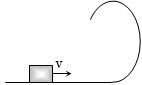
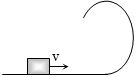
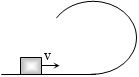
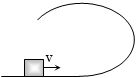
$A$ small block is shot into each of the four tracks as shown below. Each of the tracks rises to the same height. The speed with which the block enters the track is the same in all cases. At the highest point of the track,the normal reaction is maximum in
- A
- B
- C
- D
Explore More
Similar Questions
At $t = 0$,a projectile is fired from a point $O$ (taken as origin) on the ground with a speed of $50 \, m/s$ at an angle of $53^{\circ}$ with the horizontal. It passes through two points $A$ and $B$,each at a height of $75 \, m$ above the horizontal,as shown in the figure. Find the distance (in meters) of the particle from the origin at $t = 2 \, s$.
There are two points $P$ and $Q$ on a projectile path with velocities $v_P$ and $v_Q$ respectively,such that $v_P$ is perpendicular to $v_Q$. If $\alpha$ is the angle that $v_P$ makes with the horizontal at point $P$,find the correct option.
Medium
View SolutionTwo bodies are projected from the ground with the same speed $40 \ m/s$ at two different angles with respect to the horizontal. The bodies were found to have the same range. If one of the bodies was projected at an angle of $60^{\circ}$ with the horizontal,then the sum of the maximum heights attained by the two projectiles is $....... \ m$. (Given $g = 10 \ m/s^2$)
$A$ horizontal plane supports a stationary vertical cylinder of radius $R = 1 \ m$ and a disc $A$ attached to the cylinder by a horizontal thread $AB$ of length $l_0 = 2 \ m$ (seen in figure,top view). An initial velocity $v_0 = 1 \ m/s$ is imparted to the disc as shown in the figure. How many seconds will it move along the plane until it strikes against the cylinder? (All surfaces are assumed to be smooth.)
Given that $u_x$ = horizontal component of initial velocity, $u_y$ = vertical component of initial velocity, $R$ = horizontal range, $T$ = time of flight, and $H$ = maximum height of a projectile. Match the following two columns:
Column $I$ Column $II$ $(A)$ $u_x$ is doubled, $u_y$ is halved $(p)$ $H$ will remain unchanged $(B)$ $u_y$ is doubled, $u_x$ is halved $(q)$ $R$ will remain unchanged $(C)$ $u_x$ and $u_y$ both are doubled $(r)$ $R$ will become four times $(D)$ Only $u_y$ is doubled $(s)$ $H$ will become four times
| Column $I$ | Column $II$ |
| $(A)$ $u_x$ is doubled, $u_y$ is halved | $(p)$ $H$ will remain unchanged |
| $(B)$ $u_y$ is doubled, $u_x$ is halved | $(q)$ $R$ will remain unchanged |
| $(C)$ $u_x$ and $u_y$ both are doubled | $(r)$ $R$ will become four times |
| $(D)$ Only $u_y$ is doubled | $(s)$ $H$ will become four times |
Medium
View SolutionVedclass Products
For Students
Vedclass Test Series
Mock tests in real JEE/NEET style with performance analysis. 5-day free trial.
Start Free TrialFor Teachers
Exam Paper Generator
Generate Set A/B/C/D exam papers from 7.5L+ questions in 2 minutes. 3 chapters free.
Try FreeFor Institutes
Online Exam Module
Live online exams with unlimited students, 360° analytics & white-label branding.
See Demo