
$A$ uniform magnetic field $B$ and a uniform electric field $E$ act in a common region. An electron is entering this region of space. The correct arrangement for it to escape undeviated is
- A
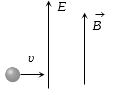
- B
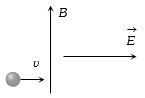
- C
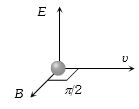
- D
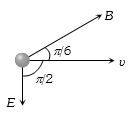
Explore More
Similar Questions
Two charged particles of specific charges in the ratio $2:1$ and masses in the ratio $1:4$ moving with same kinetic energy enter a uniform magnetic field at right angles to the direction of the field. The ratio of the radii of the circular paths in which the particles move under the influence of the magnetic field is (in $:1$)
An electron enters a region where the electrostatic field is $20\,N/C$ and the magnetic field is $5\,T$. If the electron passes undeflected through the region,then the velocity of the electron will be.....$m\,s^{-1}$.
Easy
View Solution$A$ uniform magnetic field $B$ exists in the region between $x=0$ and $x=\frac{3R}{2}$ (region $2$ in the figure) pointing normally into the plane of the paper. $A$ particle with charge $+Q$ and momentum $p$ directed along the $x$-axis enters region $2$ from region $1$ at point $P_1(y=-R)$. Which of the following option$(s)$ is/are correct?
$[A]$ For $B > \frac{2}{3} \frac{p}{QR}$,the particle will re-enter region $1$.
$[B]$ For $B = \frac{8}{13} \frac{p}{QR}$,the particle will enter region $3$ through the point $P_2$ on the $x$-axis.
$[C]$ When the particle re-enters region $1$ through the longest possible path in region $2$,the magnitude of the change in its linear momentum between point $P_1$ and the farthest point from the $y$-axis is $p/\sqrt{2}$.
$[D]$ For a fixed $B$,particles of same charge $Q$ and same velocity $v$,the distance between the point $P_1$ and the point of re-entry into region $1$ is inversely proportional to the mass of the particle.
An electron moves through a uniform magnetic field $\vec{B} = B_0 \hat{i} + 2 B_0 \hat{j} \ T$. At a particular instant of time,the velocity of the electron is $\vec{v} = 3 \hat{i} + 5 \hat{j} \ m/s$. If the magnetic force acting on the electron is $\vec{F} = 5e \hat{k} \ N$,where $e$ is the magnitude of the charge of an electron,then the value of $B_0$ is . . . . . . $T$.
DifficultJEE MAIN 2024
View SolutionThe distance moved by a charged particle along the magnetic field (the component of velocity is parallel to the magnetic field) in one rotation is given by ($m$ - mass of the particle,$v$ - velocity of the particle,$q$ - charge of the particle,$B$ - magnetic field).
Vedclass Products
For Students
Vedclass Test Series
Mock tests in real JEE/NEET style with performance analysis. 5-day free trial.
Start Free TrialFor Teachers
Exam Paper Generator
Generate Set A/B/C/D exam papers from 7.5L+ questions in 2 minutes. 3 chapters free.
Try FreeFor Institutes
Online Exam Module
Live online exams with unlimited students, 360° analytics & white-label branding.
See Demo