
$A$ viscous fluid is flowing through a cylindrical tube. The velocity distribution of the fluid is best represented by the diagram
- A
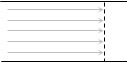
- B
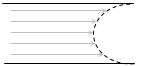
- C
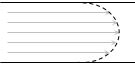
- DNone of these
Explore More
Similar Questions
The velocity of a small ball of mass $M$ and density $d_1$ when dropped in a container filled with glycerin becomes constant after some time. If the density of glycerin is $d_2$,the viscous force acting on the ball is ($g$ = acceleration due to gravity).
In an experiment to verify Stokes' law,a small spherical ball of radius $r$ and density $\rho$ falls under gravity through a distance $h$ in air before entering a tank of water. If the terminal velocity of the ball inside water is the same as its velocity just before entering the water surface,then the value of $h$ is proportional to: (ignore viscosity of air)
What is the rate at which a trapped bubble of $2 \,mm$ diameter rises through a solution of density $13.6 \times 10^3 \,kg/m^3$ and coefficient of viscosity $1.5 \,cP$ (in $\,m/s$)? Assume the density of air is negligible and $g = 10 \,m/s^2$.
$A$ ball of radius $r$ and density $\rho$ falls freely under gravity through a distance $h$ before entering water. The velocity of the ball does not change even on entering the water. If the viscosity of water is $\eta$ and the density of water is $\sigma$ (assumed to be $1$ unit for calculation),the value of $h$ is given by:
Difficult
View SolutionThe terminal velocity of a small-sized spherical body of radius $r$ falling vertically in a viscous liquid is given by the proportionality:
Medium
View SolutionVedclass Products
For Students
Vedclass Test Series
Mock tests in real JEE/NEET style with performance analysis. 5-day free trial.
Start Free TrialFor Teachers
Exam Paper Generator
Generate Set A/B/C/D exam papers from 7.5L+ questions in 2 minutes. 3 chapters free.
Try FreeFor Institutes
Online Exam Module
Live online exams with unlimited students, 360° analytics & white-label branding.
See Demo