
$A$ metal wire is clamped between two vertical walls. At $20 ^o C$,the unstrained length of the wire is exactly equal to the separation between the walls. If the temperature of the wire is decreased,the graph between elastic energy density $(u)$ and temperature $(T)$ of the wire is:
- A

- B

- C
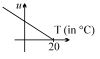
- D

Explore More
Similar Questions
Each of three blocks $P$,$Q$ and $R$ shown in the figure has a mass of $3 \,kg$. Each of the wires $A$ and $B$ has a cross-sectional area of $0.005 \,cm^2$ and a Young's modulus of $2 \times 10^{11} \,N \,m^{-2}$. Neglecting friction,the longitudinal strain on wire $B$ is . . . . . . $\times 10^{-4}$. (Take $g=10 \,m/s^2$)
Why is the maximum height of a mountain about $\sim 10 \ km$ on Earth?
Medium
View SolutionWhat are the factors on which the modulus of elasticity depends?
Medium
View Solution$A$ uniform wire of length $l$ and weight $w$ is suspended from the roof with a weight $W$ attached at the other end. The stress in the wire at a distance $l/3$ from the top is given by $(\frac{W}{A} + \gamma \frac{w}{A})$, where $A$ is the cross-sectional area of the wire. The value of $\gamma$ is . . . . . . .
DifficultJEE MAIN 2026
View Solution$A$ force $F$ is needed to break a copper wire having radius $R$. The force needed to break a copper wire of radius $2R$ will be
Easy
View SolutionVedclass Products
For Students
Vedclass Test Series
Mock tests in real JEE/NEET style with performance analysis. 5-day free trial.
Start Free TrialFor Teachers
Exam Paper Generator
Generate Set A/B/C/D exam papers from 7.5L+ questions in 2 minutes. 3 chapters free.
Try FreeFor Institutes
Online Exam Module
Live online exams with unlimited students, 360° analytics & white-label branding.
See Demo