
Assume a hypothetical wire in which free electron density changes with temperature in proportionality $n \propto T$,assuming $\tau$ (relaxation time of collision) and dimensions of the wire remain unchanged with increasing temperature. Which one of the resistance $v/s$ temperature graphs is true?
- A

- B

- C
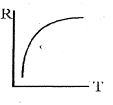
- D
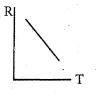
Explore More
Similar Questions
$(a)$ The electron drift speed is estimated to be only a few $mm\; s^{-1}$ for currents in the range of a few amperes. How then is current established almost the instant a circuit is closed?
$(b)$ The electron drift arises due to the force experienced by electrons in the electric field inside the conductor. But force should cause acceleration. Why then do the electrons acquire a steady average drift speed?
$(c)$ If the electron drift speed is so small,and the electron's charge is small,how can we still obtain large amounts of current in a conductor?
$(d)$ When electrons drift in a metal from lower to higher potential,does it mean that all the 'free' electrons of the metal are moving in the same direction?
$(e)$ Are the paths of electrons straight lines between successive collisions (with the positive ions of the metal) in the $(i)$ absence of electric field,$(ii)$ presence of electric field?
Medium
View SolutionDrift speed of electrons,when $1.5 \, A$ of current flows in a copper wire of cross-section $5 \, mm^2$,is $v$. If the electron density in copper is $9 \times 10^{28} \, m^{-3}$,the value of $v$ in $mm/s$ is close to (Take charge of electron to be $1.6 \times 10^{-19} \, C$).
What are called conductors and non-conductors? In which of these are free electrons more abundant: conductors or non-conductors?
Medium
View Solution$A$ potential difference $V$ is applied across the ends of a metallic wire of length $l$. The drift velocity will be doubled if:
Easy
View SolutionWhen $5\ V$ potential difference is applied across a wire of length $0.1\ m$,the drift speed of electrons is $2.5 \times 10^{-4} \ m/s$. If the electron density in the wire is $8 \times 10^{28} \ m^{-3}$,the resistivity of the material is close to:
Vedclass Products
For Students
Vedclass Test Series
Mock tests in real JEE/NEET style with performance analysis. 5-day free trial.
Start Free TrialFor Teachers
Exam Paper Generator
Generate Set A/B/C/D exam papers from 7.5L+ questions in 2 minutes. 3 chapters free.
Try FreeFor Institutes
Online Exam Module
Live online exams with unlimited students, 360° analytics & white-label branding.
See Demo