
Medium
For a reaction $A \rightarrow B$,the enthalpy of reaction is $-4.2 \ kJ \ mol^{-1}$ and the enthalpy of activation is $9.6 \ kJ \ mol^{-1}$. The correct potential energy profile for the reaction is shown in which option?
- A

- B
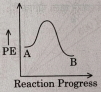
- C

- D
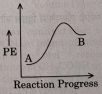
Explore More
Similar Questions
For an exothermic reaction $X \rightarrow Y$,the activation energy is $30 \ kJ \ mol^{-1}$. If the enthalpy change $(\Delta H)$ for the reaction is $-20 \ kJ \ mol^{-1}$,then the activation energy for the reverse reaction is . . . . . . $kJ \ mol^{-1}$.
Medium
View SolutionFor a chemical reaction,the rate of reaction doubles when the temperature increases by $10\,^oC$. If the temperature is increased from $10\,^oC$ to $100\,^oC$,the rate of reaction will increase by a factor of .....
Medium
View SolutionThe rate constant of a reaction depends upon
Easy
View SolutionConsider the given plots for a reaction obeying the Arrhenius equation $(0\,^{\circ}C < T < 300\,^{\circ}C)$: ($k$ and $E_a$ are rate constant and activation energy respectively). Choose the correct option.
If $E_f$ and $E_r$ are the activation energies of forward and reverse reactions and the reaction is known to be exothermic,then
Easy
View SolutionVedclass Products
For Students
Vedclass Test Series
Mock tests in real JEE/NEET style with performance analysis. 5-day free trial.
Start Free TrialFor Teachers
Exam Paper Generator
Generate Set A/B/C/D exam papers from 7.5L+ questions in 2 minutes. 3 chapters free.
Try FreeFor Institutes
Online Exam Module
Live online exams with unlimited students, 360° analytics & white-label branding.
See Demo