
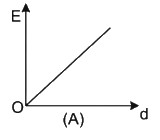
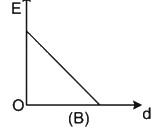
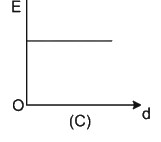
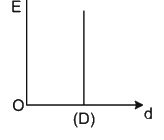
For a uniformly charged plane sheet, the variation of electric field $(E)$ with distance $(d)$ is correctly shown graphically in graph:
- A
- B
- C
- D
Explore More
Similar Questions
$A$ parallel plate capacitor consists of two metal plates. One plate is given a charge of $+q$,while the other is connected to the ground. Points $P, P_1$,and $P_2$ are taken as shown in the figure. At which point is the electric field $NOT$ zero?
Easy
View SolutionThe electric intensity due to an infinite cylinder of radius $R$ and having charge $q$ per unit length at a distance $r(r > R)$ from its axis is
Easy
View SolutionIn the figure,a very large plane sheet of positive charge is shown. $P_{1}$ and $P_{2}$ are two points at distances $l$ and $2l$ from the charge distribution. If $\sigma$ is the surface charge density,then the magnitude of electric fields $E_{1}$ and $E_{2}$ at $P_{1}$ and $P_{2}$ respectively are:
What will be the total electric flux through the faces of the cube of side length '$a$' if a charge '$Q$' is placed at '$B$', the midpoint of an edge of the cube (see figure)?
DifficultKCET 2026
View SolutionLet a total charge $2Q$ be distributed in a sphere of radius $R$,with the charge density given by $\rho(r) = kr$,where $r$ is the distance from the centre. Two charges $A$ and $B$,of $-Q$ each,are placed on diametrically opposite points,at equal distance $a$ from the centre. If $A$ and $B$ do not experience any force,then:
DifficultJEE MAIN 2019
View SolutionVedclass Products
For Students
Vedclass Test Series
Mock tests in real JEE/NEET style with performance analysis. 5-day free trial.
Start Free TrialFor Teachers
Exam Paper Generator
Generate Set A/B/C/D exam papers from 7.5L+ questions in 2 minutes. 3 chapters free.
Try FreeFor Institutes
Online Exam Module
Live online exams with unlimited students, 360° analytics & white-label branding.
See Demo