
For the chemical reaction $CaCO_{3(s)} \rightleftharpoons CaO_{(s)} + CO_{2(g)}$,$\Delta H^o$ of reaction can be determined from which one of the following plots?
- A
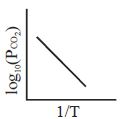
- B
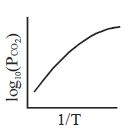
- C
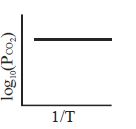
- D
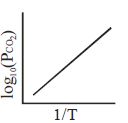
Explore More
Similar Questions
For the formation of $NH_3$ from $N_2$ and $H_2$ at $500 \ K$,the concentrations of $N_2, H_2$ and $NH_3$ at equilibrium are $1.5 \times 10^{-2} \ M, 3.0 \times 10^{-2} \ M$ and $1.2 \times 10^{-2} \ M$,respectively. The equilibrium constant for the reverse reaction is
$A_{(g)} \rightleftharpoons B_{(g)} + \frac{1}{2} C_{(g)}$. The correct relationship between $K_P$,$\alpha$,and equilibrium pressure $P$ is:
DifficultJEE MAIN 2024
View Solution$\Delta n$,the change in the number of moles for the reaction,$C_{12}H_{22}O_{11(s)} + 12O_{2(g)} \rightleftharpoons 12CO_{2(g)} + 11H_2O_{(l)}$ at $25 \ ^\circ C$ is
Easy
View SolutionFor a reversible reaction $A \rightleftharpoons B$,the pre-exponential factor is the same for both the forward and backward reactions and has a value of $20 \ s^{-1}$. If the enthalpy change for the forward reaction is $-41.5 \ kJ \ mol^{-1}$,the value of the equilibrium constant at $500 \ K$ is:
For the reaction $NH_4HS_{(s)} \rightleftharpoons NH_{3(g)} + H_2S_{(g)}$,if the total pressure in the reaction vessel at $105 \ ^\circ C$ is $1.12 \ atm$,then the $K_p$ for this equilibrium will be .........
Difficult
View SolutionVedclass Products
For Students
Vedclass Test Series
Mock tests in real JEE/NEET style with performance analysis. 5-day free trial.
Start Free TrialFor Teachers
Exam Paper Generator
Generate Set A/B/C/D exam papers from 7.5L+ questions in 2 minutes. 3 chapters free.
Try FreeFor Institutes
Online Exam Module
Live online exams with unlimited students, 360° analytics & white-label branding.
See Demo