
In which of the following cases is the junction diode $NOT$ in reverse bias?
- A
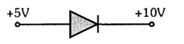
- B
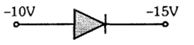
- C
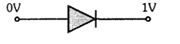
- D

Explore More
Similar Questions
The time variations of signals $A, B$ and $C$ are shown below. Choose the correct statement.
Medium
View SolutionIn the circuit given below, $V(t)$ is the sinusoidal voltage source. The voltage drop $V_{AB}(t)$ across the resistance $R$ is:
MediumIIT 1993
View Solution$A$ $p-n$ junction diode cannot be used
The box in the circuit below has two inputs marked $V_{+}$ and $V_{-}$ and a single output marked $V_{o}$. The output obeys the following relation:
$V_{o} = \begin{cases} +10 \, V & \text{if } V_{+} > V_{-} \\ -10 \, V & \text{if } V_{+} < V_{-} \end{cases}$
Which of the following graphs represents the output $V_{o}$ as a function of time $t$?
$V_{o} = \begin{cases} +10 \, V & \text{if } V_{+} > V_{-} \\ -10 \, V & \text{if } V_{+} < V_{-} \end{cases}$
Which of the following graphs represents the output $V_{o}$ as a function of time $t$?
$Ge$ and $Si$ diodes conduct at $0.3 \, V$ and $0.7 \, V$ respectively. In the following figure,if the $Ge$ diode connection is reversed,the value of $V_0$ changes by how many volts?
DifficultJEE MAIN 2019
View SolutionVedclass Products
For Students
Vedclass Test Series
Mock tests in real JEE/NEET style with performance analysis. 5-day free trial.
Start Free TrialFor Teachers
Exam Paper Generator
Generate Set A/B/C/D exam papers from 7.5L+ questions in 2 minutes. 3 chapters free.
Try FreeFor Institutes
Online Exam Module
Live online exams with unlimited students, 360° analytics & white-label branding.
See Demo