
In which of the following circuits is the junction reverse biased?
- A
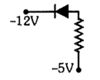
- B

- C
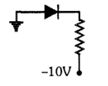
- D
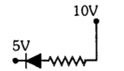
Explore More
Similar Questions
In an oscillator,for sustained oscillations,the Barkhausen criterion is $A \beta$ equal to (where $A =$ voltage gain without feedback,$\beta =$ feedback factor).
In the circuit given below, $V(t)$ is the sinusoidal voltage source. The voltage drop $V_{AB}(t)$ across the resistance $R$ is:
MediumIIT 1993
View SolutionThe resultant voltage gain in a series combination of two or more amplifiers is .......
Arvind needs to identify the electrical components from a group of components labelled as $A, B, C$ and $D$. He performed some simple tests and obtained the following observations:
$(a)$ $A$ has a silver ring at one end,with two terminals. It conducts electricity only in one direction.
$(b)$ $B$ is connected to a $D.C.$ source,but the current gradually decreases and becomes zero. It is a two-terminal device and behaves the same in both directions.
$(c)$ $C$ is a two-terminal device,which conducts electricity only in one direction,while emitting light.
$(d)$ $D$ is a two-terminal device with several coloured rings on it. It conducts current in both directions with the same steady current.
The correct identification of $A, B, C$ and $D$ are respectively:
Difficult
View SolutionThe correct curve between voltage gain $({A_v})$ and load resistance $({R_L})$ is
Medium
View SolutionVedclass Products
For Students
Vedclass Test Series
Mock tests in real JEE/NEET style with performance analysis. 5-day free trial.
Start Free TrialFor Teachers
Exam Paper Generator
Generate Set A/B/C/D exam papers from 7.5L+ questions in 2 minutes. 3 chapters free.
Try FreeFor Institutes
Online Exam Module
Live online exams with unlimited students, 360° analytics & white-label branding.
See Demo