
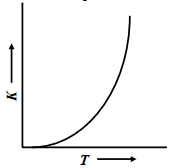
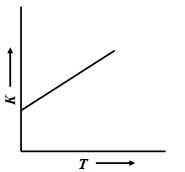
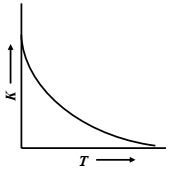
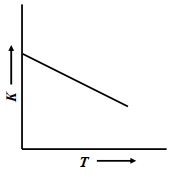
Plots showing the variation of the rate constant $k$ with temperature $T$ are given below. The plot that follows Arrhenius equation is
- A
- B
- C
- D
Explore More
Similar Questions
The decomposition of $A$ into product has a value of $k$ as $4.5 \times 10^{3} \, s^{-1}$ at $10^{\circ} C$ and an energy of activation of $60 \, kJ \, mol^{-1}$. At what temperature would $k$ be $1.5 \times 10^{4} \, s^{-1}$?
Difficult
View SolutionActivation energy $(E_a)$ and rate constants $(k_1)$ and $(k_2)$ of a chemical reaction at two different temperatures $(T_1)$ and $(T_2)$ are related by
MediumAIPMT 2012
View SolutionWhich is a wrong statement?
DifficultKCET 2019
View SolutionWhat happens to the most probable kinetic energy and the energy of activation with an increase in temperature?
Difficult
View Solution$A \rightarrow B$. The molecule $A$ changes into its isomeric form $B$ following first-order kinetics at a temperature of $1000 \ K$. If the energy barrier with respect to reactant energy for such isomeric transformation is $191.48 \ kJ \ mol^{-1}$ and the frequency factor is $10^{20} \ s^{-1}$,the time required for $50 \%$ of molecules of $A$ to become $B$ is $..............$ picoseconds (nearest integer). $[R = 8.314 \ J \ K^{-1} \ mol^{-1}]$
DifficultJEE MAIN 2025
View SolutionVedclass Products
For Students
Vedclass Test Series
Mock tests in real JEE/NEET style with performance analysis. 5-day free trial.
Start Free TrialFor Teachers
Exam Paper Generator
Generate Set A/B/C/D exam papers from 7.5L+ questions in 2 minutes. 3 chapters free.
Try FreeFor Institutes
Online Exam Module
Live online exams with unlimited students, 360° analytics & white-label branding.
See Demo