
The charge density $P$ in a nucleus varies with distance $r$ from the centre of the nucleus according to the curve in the figure. Which of the following graphs correctly represents this variation?
- A
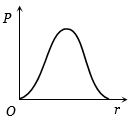
- B
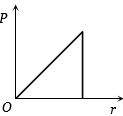
- C
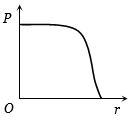
- D
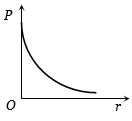
Explore More
Similar Questions
The atomic masses of two isotopes of an element are $34.98 \ u$ and $36.98 \ u$ and their relative abundances are $75.4 \%$ and $24.6 \%$ respectively. The average atomic mass of the element is: (in $u$)
Nuclei with magic numbers of protons $Z = 2, 8, 20, 28, 50, 82$ and magic numbers of neutrons $N = 2, 8, 20, 28, 50, 82, 126$ are found to be very stable.
$(i)$ Verify this by calculating the proton separation energy $S_p$ for $^{120}Sn$ $(Z = 50)$ and $^{121}Sb$ $(Z = 51)$. The proton separation energy for a nuclide is the minimum energy required to separate the least tightly bound proton from a nucleus of that nuclide. It is given by $S_p = (M_{Z-1, N} + M_H - M_{Z, N})c^2$. Given:
$^{119}In = 118.9058 \ u, ^{120}Sn = 119.902199 \ u, ^{121}Sb = 120.903824 \ u, ^1H = 1.0078252 \ u$
$(ii)$ What does the existence of magic numbers indicate?
Medium
View SolutionCalculate the height of the potential barrier for a head-on collision of two deuterons. (Radius of deuteron is $2$ fm).
DifficultGUJCET 2025
View Solution$A$ nucleus splits into two parts. If the ratio of their velocities is $8 : 1$, what is the ratio of their radii?
Difficult
View SolutionConsider a nucleus ${ }_{30}^{60} X$. Its approximate density is (Take $1 \text{ amu} = 1.6 \times 10^{-27} \text{ kg}$, $R_0 = 1.2 \times 10^{-15} \text{ m}$)
Vedclass Products
For Students
Vedclass Test Series
Mock tests in real JEE/NEET style with performance analysis. 5-day free trial.
Start Free TrialFor Teachers
Exam Paper Generator
Generate Set A/B/C/D exam papers from 7.5L+ questions in 2 minutes. 3 chapters free.
Try FreeFor Institutes
Online Exam Module
Live online exams with unlimited students, 360° analytics & white-label branding.
See Demo