
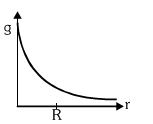
The dependence of acceleration due to gravity $g$ on the distance $r$ from the centre of the earth, assumed to be a sphere of radius $R$ of uniform density, is as shown in which of the following figures?
- A
- BGraph showing $g$ increasing linearly with $r$ for $r < R$ and decreasing as $1/r^2$ for $r > R$.
- C
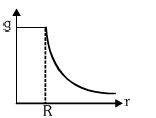
- D
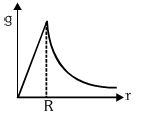
Explore More
Similar Questions
If the mass and radius of a planet are double those of the Earth,what will be the acceleration due to gravity on this planet compared to the acceleration due to gravity on Earth?
Easy
View SolutionTwo satellites $P$ and $Q$ are moving in different circular orbits around the Earth (radius $R$). The heights of $P$ and $Q$ from the Earth's surface are $h_p$ and $h_Q$,respectively,where $h_p = R / 3$. The accelerations of $P$ and $Q$ due to Earth's gravity are $g_p$ and $g_Q$,respectively. If $g_p / g_Q = 36 / 25$,what is the value of $h_Q$?
MediumIIT 2023
View SolutionAssuming the density of the Earth is constant, which graph correctly represents the variation of acceleration due to gravity $(g)$ with the distance $(r)$ from the center of the Earth (radius of the Earth $= R$)?
MediumAIEEE 2012
View SolutionThe average density of the Earth is [ $g$ is acceleration due to gravity]:
$A$ newly discovered planet has a density eight times the density of the earth and a radius twice the radius of the earth. The time taken by a $2\, kg$ mass to fall freely through a distance $S$ near the surface of the earth is $1$ second. Then the time taken for a $4\, kg$ mass to fall freely through the same distance $S$ near the surface of the new planet is ....... $\sec$.
Vedclass Products
For Students
Vedclass Test Series
Mock tests in real JEE/NEET style with performance analysis. 5-day free trial.
Start Free TrialFor Teachers
Exam Paper Generator
Generate Set A/B/C/D exam papers from 7.5L+ questions in 2 minutes. 3 chapters free.
Try FreeFor Institutes
Online Exam Module
Live online exams with unlimited students, 360° analytics & white-label branding.
See Demo