
Class 12PhysicsElectrostatic Potential and CapacitanceRelation between Electric Field and Potential and Potential Gradient
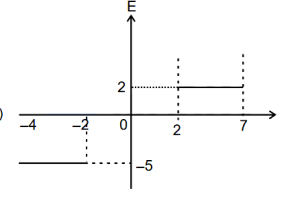
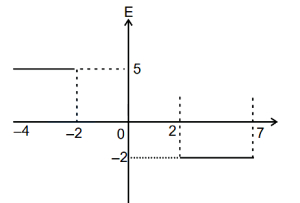
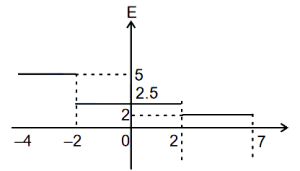
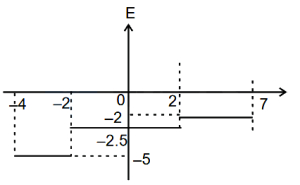
MediumThe electric potential for an electric field directed parallel to $X$-axis is shown in the figure. Choose the correct plot of electric field strength.
- A
- B
- C
- D
Explore More
Similar Questions
In a certain region of space,the potential is given by: $V = k[2x^2 - y^2 + z^2]$. The electric field at the point $(1, 1, 1)$ has magnitude =
Medium
View SolutionThe electric potential at a point $(x, y, z)$ is given by $V = -x^2y - xz^3 + 4$. The electric field at that point is:
The electric potential $V(x, y, z)$ for a planar charge distribution is given by:
$V(x, y, z) = \begin{cases} 0 & \text{for } x < -d \\ -V_0(1 + \frac{x}{d})^2 & \text{for } -d \le x < 0 \\ -V_0(1 + 2\frac{x}{d}) & \text{for } 0 \le x < d \\ -3V_0 & \text{for } x \ge d \end{cases}$
where $-V_0$ is the potential at the origin and $d$ is a distance. The graph of the electric field as a function of position is:
Difficult
View SolutionThe electric potential at any point as a function of distance $(x)$ in meters is given by $V = 5x^2 + 10x - 9 \, (V)$. The value of the electric field at $x = 1 \, m$ is ...... $V m^{-1}$.
Easy
View SolutionIf $V = -5x + 3y + \sqrt{15}z$,then find the magnitude of the electric field $E(x, y, z)$ in units.
Easy
View SolutionVedclass Products
For Students
Vedclass Test Series
Mock tests in real JEE/NEET style with performance analysis. 5-day free trial.
Start Free TrialFor Teachers
Exam Paper Generator
Generate Set A/B/C/D exam papers from 7.5L+ questions in 2 minutes. 3 chapters free.
Try FreeFor Institutes
Online Exam Module
Live online exams with unlimited students, 360° analytics & white-label branding.
See Demo