
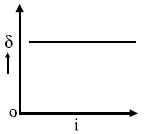
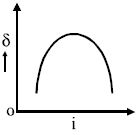
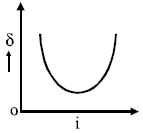
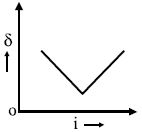
The graph between angle of deviation $(\delta)$ and angle of incidence $(i)$ for a triangular prism is represented by :-
- A
- B
- C
- D
Explore More
Similar Questions
$A$ thin prism of angle $15^o$ made of glass of refractive index $\mu_1 = 1.5$ is combined with another prism of glass of refractive index $\mu_2 = 1.75$. The combination of the prisms produces dispersion without deviation. The angle of the second prism should be ......$^o$
MediumAIPMT 2011
View SolutionThe angle of deviation through a prism is minimum when
$(A)$ Incident ray and emergent ray are symmetric to the prism
$(B)$ The refracted ray inside the prism becomes parallel to its base
$(C)$ Angle of incidence is equal to that of the angle of emergence
$(D)$ When angle of emergence is double the angle of incidence
Choose the correct answer from the options given below
If the angle of a prism is $60^{\circ}$ and the angle of minimum deviation is $40^{\circ}$,then the angle of refraction will be (in $^{\circ}$)
$A$ beam of monochromatic light is incident at $i = 50^{\circ}$ on one face of an equilateral prism. If the angle of emergence is $e = 40^{\circ}$,then the angle of minimum deviation $\delta_m$ is:
Medium
View Solution$A$ prism of refracting angle $60^\circ$ is made with a material of refractive index $\mu$. For a certain wavelength of light,the angle of minimum deviation is $30^\circ$. For this wavelength,the value of the refractive index of the material is:
Medium
View SolutionVedclass Products
For Students
Vedclass Test Series
Mock tests in real JEE/NEET style with performance analysis. 5-day free trial.
Start Free TrialFor Teachers
Exam Paper Generator
Generate Set A/B/C/D exam papers from 7.5L+ questions in 2 minutes. 3 chapters free.
Try FreeFor Institutes
Online Exam Module
Live online exams with unlimited students, 360° analytics & white-label branding.
See Demo