
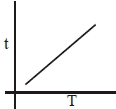
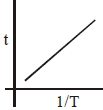
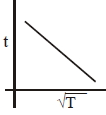
The plot that depicts the behavior of the mean free time $t$ (time between two successive collisions) for the molecules of an ideal gas,as a function of temperature $(T)$,qualitatively,is (Graphs are schematic and not drawn to scale)
- A
- B
- C
- D
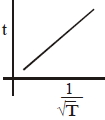
Explore More
Similar Questions
The difference between volume and pressure coefficients of an ideal gas is
Fill in the blanks:
$(i)$ At low $......$ and high $......$ temperature,real gases behave as an ideal gas.
$(ii)$ $......$ is a measure of the average kinetic energy of a gas.
$(iii)$ The kinetic energy of a gas with mass $m$ is $E$. Its momentum will be $......$.
$(iv)$ At $......$ temperature,$v_{rms}$ will be double that of $v_{rms}$ at $0^{\circ} C$.
Medium
View SolutionAn ideal gas is expanding such that $PT^{3} = \text{constant}$. The coefficient of volume expansion of the gas is: (in $/T$)
DifficultJEE MAIN 2021
View SolutionThe total internal energy of $2$ moles of a monatomic gas at a temperature $27^{\circ} C$ is $U$. The total internal energy of $3$ moles of a diatomic gas at a temperature $127^{\circ} C$ is:
$N$ molecules each of mass $m$ of gas $A$ and $2N$ molecules each of mass $2m$ of gas $B$ are contained in the same vessel at temperature $T$. The mean square of the velocity of molecules of gas $B$ is $v^2$ and the mean square of $x$ component of the velocity of molecules of gas $A$ is $w^2$. The ratio $\frac{w^2}{v^2}$ is
Difficult
View SolutionVedclass Products
For Students
Vedclass Test Series
Mock tests in real JEE/NEET style with performance analysis. 5-day free trial.
Start Free TrialFor Teachers
Exam Paper Generator
Generate Set A/B/C/D exam papers from 7.5L+ questions in 2 minutes. 3 chapters free.
Try FreeFor Institutes
Online Exam Module
Live online exams with unlimited students, 360° analytics & white-label branding.
See Demo