
There is a uniform spherically symmetric surface charge density at a distance $R_0$ from the origin. The charge distribution is initially at rest and starts expanding because of mutual repulsion. The figure that represents best the speed $V(R(t))$ of the distribution as a function of its instantaneous radius $R(t)$ is
- A
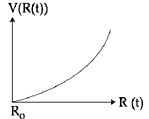
- B
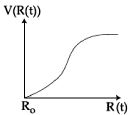
- C
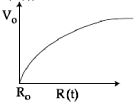
- D
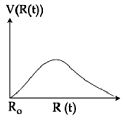
Explore More
Similar Questions
Two identical charged spheres suspended from a common point by two massless strings of lengths $l$ are initially at a distance $d$ $(d << l)$ apart because of their mutual repulsion. The charges begin to leak from both the spheres at a constant rate. As a result,the spheres approach each other with a velocity $v$. Then $v$ varies as a function of the distance $x$ between the spheres,as:
DifficultAIEEE 2011
View SolutionAnswer carefully:
$(a)$ Two large conducting spheres carrying charges $Q_{1}$ and $Q_{2}$ are brought close to each other. Is the magnitude of electrostatic force between them exactly given by $Q_{1} Q_{2} / 4 \pi \varepsilon_{0} r^{2}$,where $r$ is the distance between their centres?
$(b)$ If Coulomb's law involved $1/r^{3}$ dependence (instead of $1/r^{2}$),would Gauss's law be still true?
$(c)$ $A$ small test charge is released at rest at a point in an electrostatic field configuration. Will it travel along the field line passing through that point?
$(d)$ What is the work done by the field of a nucleus in a complete circular orbit of the electron? What if the orbit is elliptical?
$(e)$ We know that electric field is discontinuous across the surface of a charged conductor. Is electric potential also discontinuous there?
$(f)$ What meaning would you give to the capacitance of a single conductor?
$(g)$ Guess a possible reason why water has a much greater dielectric constant $(=80)$ than,say,mica $(=6)$?
Medium
View SolutionOne moving electron when comes closer to another stationary electron,then its kinetic energy and potential energy respectively . . . . . . and . . . . . . .
Two identical non-conducting thin hemispherical shells,each of radius $R$,are brought into contact to form a complete sphere. If a total charge $Q$ is uniformly distributed on them,what is the minimum force $F$ required to hold them together?
Medium
View SolutionAn oil drop carries six electronic charges,has a mass of $1.6 \times 10^{-12} \text{ g}$ and falls with a terminal velocity in air. The magnitude of the vertical electric field required to make the drop move upward with the same speed as it was formerly moving is ........$kN/C$.
Medium
View SolutionVedclass Products
For Students
Vedclass Test Series
Mock tests in real JEE/NEET style with performance analysis. 5-day free trial.
Start Free TrialFor Teachers
Exam Paper Generator
Generate Set A/B/C/D exam papers from 7.5L+ questions in 2 minutes. 3 chapters free.
Try FreeFor Institutes
Online Exam Module
Live online exams with unlimited students, 360° analytics & white-label branding.
See Demo