
Class 12PhysicsElectrostatic Potential and CapacitanceMix Examples - Electric Potential and Capacitance
MediumTwo thin dielectric slabs of dielectric constants $K_1$ and $K_2$ $(K_1 < K_2)$ are inserted between the plates of a parallel plate capacitor,as shown in the figure. The variation of the electric field $E$ between the plates with distance $d$ as measured from plate $P$ is correctly shown by:
- A
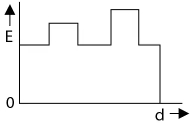
- B
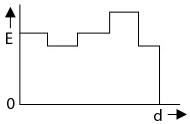
- C
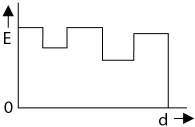
- D
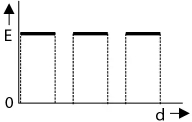
Explore More
Similar Questions
In the figure, a potential of $+1200\, V$ is applied to point $A$ and point $B$ is earthed. What is the potential at point $P$ in volts?
Medium
View Solution$A$ parallel plate capacitor is charged and then disconnected from the source of steady $E.M.F.$ The plates are then drawn apart farther. Again it is connected to the same source. Then:
Easy
View SolutionChoose the correct statement for the given capacitor arrangement. (All the $6$ capacitors are of same capacitance)
Medium
View SolutionIn the adjoining figure,three capacitors $C_1$,$C_2$,and $C_3$ are connected to a battery of potential $V$. The correct condition is (Symbols have their usual meanings):
Medium
View SolutionSix point charges are kept at the vertices of a regular hexagon of side $L$ and centre $O$,as shown in the figure. Given that $K = \frac{1}{4 \pi \varepsilon_0} \frac{q}{L^2}$,which of the following statement$(s)$ is (are) correct?
$(A)$ The electric field at $O$ is $6K$ along $OD$
$(B)$ The potential at $O$ is zero
$(C)$ The potential at all points on the line $PR$ is same
$(D)$ The potential at all points on the line $ST$ is same.
$(A)$ The electric field at $O$ is $6K$ along $OD$
$(B)$ The potential at $O$ is zero
$(C)$ The potential at all points on the line $PR$ is same
$(D)$ The potential at all points on the line $ST$ is same.
DifficultIIT 2012
View SolutionVedclass Products
For Students
Vedclass Test Series
Mock tests in real JEE/NEET style with performance analysis. 5-day free trial.
Start Free TrialFor Teachers
Exam Paper Generator
Generate Set A/B/C/D exam papers from 7.5L+ questions in 2 minutes. 3 chapters free.
Try FreeFor Institutes
Online Exam Module
Live online exams with unlimited students, 360° analytics & white-label branding.
See Demo