
Class 11PhysicsMechanical Properties of FluidsBernoulli's Theorem and Applications of Bernoulli's Theory
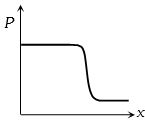
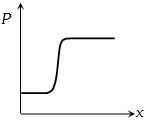
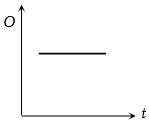
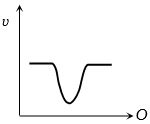
MediumWater flows through a frictionless duct with a cross-section varying as shown in the figure. The pressure $p$ at points along the axis is represented by:
- A
- B
- C
- D
Explore More
Similar Questions
$A$ liquid enters at point $A_{1}$ with a speed of $3.5 \ m/s$ and leaves at point $A_{2}$. Find the height attained by the liquid above point $A_{2}$ (in $cm$). (in $.25$)
MediumAIIMS 2019
View SolutionTwo light balls are suspended as shown in the figure. When a stream of air passes through the space between them,the distance between the balls will
DifficultMHT CET 2019
View SolutionState Bernoulli's equation in words and write its mathematical formula.
Medium
View SolutionAs shown in the figure, a pump is designed as a horizontal cylinder with a piston having area $A$ and an outlet orifice having an area $a$. The piston moves with a constant velocity under the action of force $F$. If the density of the liquid is $\rho$, then the speed of the liquid emerging from the orifice is (assume $A \gg a$):
DifficultWBJEE 2023
View SolutionWater from a tap emerges vertically downwards with an initial velocity of $4 \,m/s$. The cross-sectional area of the tap is $A$. The flow is steady and the pressure is constant throughout the stream of water. The distance $h$ vertically below the tap,where the cross-sectional area of the stream becomes $\frac{2}{3} A$,is (take $g = 10 \,m/s^2$): (in $\,m$)
DifficultAP EAMCET 2010
View SolutionVedclass Products
For Students
Vedclass Test Series
Mock tests in real JEE/NEET style with performance analysis. 5-day free trial.
Start Free TrialFor Teachers
Exam Paper Generator
Generate Set A/B/C/D exam papers from 7.5L+ questions in 2 minutes. 3 chapters free.
Try FreeFor Institutes
Online Exam Module
Live online exams with unlimited students, 360° analytics & white-label branding.
See Demo