
Class 11Physics1 Thermal Properties of Matter: Thermometry, Expansion and CalorimetryThermal Expansion for fluid
EasyWhich of the following curves represent the variation of coefficient of volume expansion of an ideal gas at constant pressure?
- A
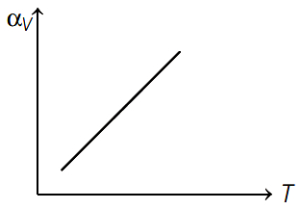
- B
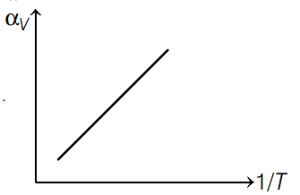
- C
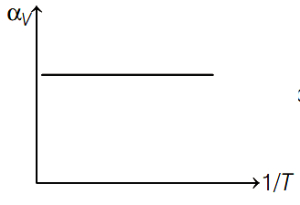
- D
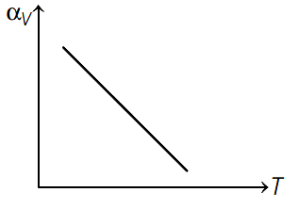
Explore More
Similar Questions
Where is the coefficient of volume expansion $\alpha_V$ greater: in alcohol or mercury?
Easy
View Solution$A$ liquid having a coefficient of cubical expansion $\gamma$ is kept in a copper vessel having a coefficient of linear expansion $\alpha = \frac{\gamma}{3}$. If heat is supplied to the vessel,the original level of the liquid in the vessel will
What is $\alpha_V$? On what value of $\alpha_V$ depends? Write its unit.
Easy
View Solution$A$ glass flask of volume $1 \, L$ is completely filled with mercury at $0 \, ^\circ C$. The temperature of the glass flask and mercury is raised to $100 \, ^\circ C$. If the coefficient of volume expansion of mercury is $1.82 \times 10^{-4} \, ^\circ C^{-1}$ and the coefficient of linear expansion of glass is $0.1 \times 10^{-4} \, ^\circ C^{-1}$,how much mercury will overflow from the flask? (in $cm^3$)
Difficult
View SolutionThe graph between volume and temperature for a gas is shown in the figure. If $\alpha$ = volume coefficient of the gas = $\frac{1}{273} \text{ per } ^oC$,then what is the volume of the gas at a temperature of $819 ^oC$?
Medium
View SolutionVedclass Products
For Students
Vedclass Test Series
Mock tests in real JEE/NEET style with performance analysis. 5-day free trial.
Start Free TrialFor Teachers
Exam Paper Generator
Generate Set A/B/C/D exam papers from 7.5L+ questions in 2 minutes. 3 chapters free.
Try FreeFor Institutes
Online Exam Module
Live online exams with unlimited students, 360° analytics & white-label branding.
See Demo