
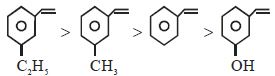
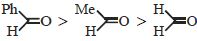
Which of the following is the correct order of reactivity for:
- A(Electrophilic addition reaction)
- B(Grignard's reagent)
- C$R-F > R-Cl > R-Br > R-I$ (Wurtz reaction)
- D$I_2 > F_2 > Br_2 > Cl_2$ (Halogenation of alkanes)
Explore More
Similar Questions
What is the fission of a covalent bond? Explain its types with examples and the main differences.
Difficult
View SolutionDifferent possible thermal decomposition pathways for peroxyesters are shown below. Match each pathway from List-$I$ with an appropriate structure from List-$II$ and select the correct answer using the code given below the lists.
List-$I$:
$P$. Pathway $P$
$Q$. Pathway $Q$
$R$. Pathway $R$
$S$. Pathway $S$
List-$II$:
$1$. $C_6H_5CH_2CO_3CH_3$
$2$. $C_6H_5CO_3CH_3$
$3$. $C_6H_5CH_2CO_3C(CH_3)_2CH_2C_6H_5$
$4$. $C_6H_5CO_3C(CH_3)_2C_6H_5$
Codes:
$P \quad Q \quad R \quad S$
$A. 1 \quad 3 \quad 4 \quad 2$
$B. 2 \quad 4 \quad 3 \quad 1$
$C. 4 \quad 1 \quad 2 \quad 3$
$D. 3 \quad 2 \quad 1 \quad 4$
State True or False for the following statements:
$(i)$ Positive and negative ions are formed by homolytic cleavage of a covalent bond.
$(ii)$ Positive and negative ions are formed by heterolytic cleavage of a covalent bond.
$(iii)$ Only homolytic cleavage is possible in the $C-Cl$ bond of $CH_3-Cl$.
$(iv)$ If heterolytic cleavage of a bond occurs,then ionic or polar type reactions take place.
Medium
View SolutionHow many transition states and intermediates will be formed during the course of the following reaction?
Medium
View SolutionIf heterolytic and homolytic cleavage of a bond occurs,then which types of reactions occur?
Medium
View SolutionVedclass Products
For Students
Vedclass Test Series
Mock tests in real JEE/NEET style with performance analysis. 5-day free trial.
Start Free TrialFor Teachers
Exam Paper Generator
Generate Set A/B/C/D exam papers from 7.5L+ questions in 2 minutes. 3 chapters free.
Try FreeFor Institutes
Online Exam Module
Live online exams with unlimited students, 360° analytics & white-label branding.
See Demo