
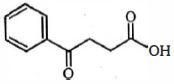
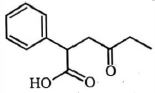
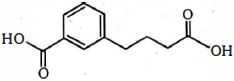
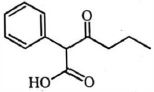
Which of the following undergoes decarboxylation most readily on being heated?
- A
- B
- C
- D
Explore More
Similar Questions
Hydrolysis of an ester gives acid $A$ and alcohol $B$. $A$ reduces Fehling solution and oxidation of $B$ gives $A$. The ester is
Medium
View SolutionThe products $A$ and $B$ in the following reaction sequence are:
DifficultNEET 2022
View SolutionAn organic compound $[A]$,molecular formula $C_{10}H_{20}O_2$,was hydrolyzed with dilute sulphuric acid to give a carboxylic acid $[B]$ and an alcohol $[C]$. Oxidation of $[C]$ with $CrO_3-H_2SO_4$ produced $[B]$. Which of the following structures are not possible for $[A]$?
Arrange the following compounds in the correct order of their boiling points:
$(I) \, CH_3CH_2CH_2CH_2OH$
$(II) \, CH_3CH_2CH_2CHO$
$(III) \, CH_3CH_2CH_2COOH$
$(I) \, CH_3CH_2CH_2CH_2OH$
$(II) \, CH_3CH_2CH_2CHO$
$(III) \, CH_3CH_2CH_2COOH$
Medium
View SolutionMatch the formulas in Column-$I$ with their names in Column-$II$.
Column-$I$ (formula)
Column-$II$ (name)
$A$. $RCH=NH$
$i$. Diisobutyl aluminium hydride
$B$. $AlH(i-Bu)_2$
$ii$. Benzalchloride
$C$. $C_6H_5-CH(OCOCH_3)_2$
$iii$. Imine
$D$. $C_6H_5CHCl_2$
$iv$. Benzylidene diacetate
| Column-$I$ (formula) | Column-$II$ (name) |
| $A$. $RCH=NH$ | $i$. Diisobutyl aluminium hydride |
| $B$. $AlH(i-Bu)_2$ | $ii$. Benzalchloride |
| $C$. $C_6H_5-CH(OCOCH_3)_2$ | $iii$. Imine |
| $D$. $C_6H_5CHCl_2$ | $iv$. Benzylidene diacetate |
Medium
View SolutionVedclass Products
For Students
Vedclass Test Series
Mock tests in real JEE/NEET style with performance analysis. 5-day free trial.
Start Free TrialFor Teachers
Exam Paper Generator
Generate Set A/B/C/D exam papers from 7.5L+ questions in 2 minutes. 3 chapters free.
Try FreeFor Institutes
Online Exam Module
Live online exams with unlimited students, 360° analytics & white-label branding.
See Demo