
Which of the following wiring diagrams could be used to experimentally determine $R$ using Ohm's law? Assume an ideal voltmeter and an ideal ammeter.
- A
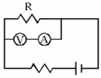
- B
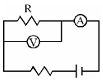
- C
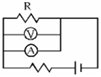
- D
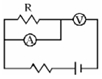
Explore More
Similar Questions
Two cells $A$ and $B$ of emf $2 \text{ V}$ and $1.5 \text{ V}$ respectively, are connected as shown in the figure through an external resistance $10 \text{ } \Omega$. The internal resistance of each cell is $5 \text{ } \Omega$. The potential difference $V_{A}$ and $V_{B}$ across the terminals of the cells $A$ and $B$ respectively are:
MediumWBJEE 2015
View SolutionFind the percentage error in the reading of the voltmeter shown in the circuit. (in $\%$)
Medium
View SolutionAnswer the following questions:
$(a)$ $A$ steady current flows in a metallic conductor of non-uniform cross-section. Which of these quantities is constant along the conductor: current, current density, electric field, drift speed?
$(b)$ Is Ohm's law universally applicable for all conducting elements? If not, give examples of elements which do not obey Ohm's law.
$(c)$ $A$ low voltage supply from which one needs high currents must have very low internal resistance. Why?
$(d)$ $A$ high tension $(HT)$ supply of, say, $6 \ kV$ must have a very large internal resistance. Why?
Medium
View SolutionThe bulb which glows with maximum intensity in the given circuit is
Two wires '$A$' and '$B$' of the same material have their lengths in the ratio $1 : 2$ and radii in the ratio $2 : 1$. The two wires are connected in parallel across a battery. The ratio of the heat produced in '$A$' to the heat produced in '$B$' for the same time is
Medium
View SolutionVedclass Products
For Students
Vedclass Test Series
Mock tests in real JEE/NEET style with performance analysis. 5-day free trial.
Start Free TrialFor Teachers
Exam Paper Generator
Generate Set A/B/C/D exam papers from 7.5L+ questions in 2 minutes. 3 chapters free.
Try FreeFor Institutes
Online Exam Module
Live online exams with unlimited students, 360° analytics & white-label branding.
See Demo