
A English
Mix Examples - Coordinate Geometry Questions in English
Class 10 Mathematics · Coordinate Geometry · Mix Examples - Coordinate Geometry
99+
Questions
English
Language
100%
With Solutions
Showing 50 of 99 questions in English
1
MediumMCQ
Determine if the points $(1,5), (2,3),$ and $(-2,-11)$ are collinear.
A
Yes,they are collinear.
B
No,they are not collinear.
C
They form a right-angled triangle.
D
They form an equilateral triangle.
Solution
(B) Let the points be $A(1,5), B(2,3),$ and $C(-2,-11)$.
To check if the points are collinear,we calculate the area of the triangle formed by these points using the formula:
$\text{Area} = \frac{1}{2} |x_1(y_2 - y_3) + x_2(y_3 - y_1) + x_3(y_1 - y_2)|$
Substituting the values:
$\text{Area} = \frac{1}{2} |1(3 - (-11)) + 2(-11 - 5) + (-2)(5 - 3)|$
$\text{Area} = \frac{1}{2} |1(14) + 2(-16) + (-2)(2)|$
$\text{Area} = \frac{1}{2} |14 - 32 - 4|$
$\text{Area} = \frac{1}{2} |-22| = 11 \text{ square units}$.
Since the area of the triangle is not $0$,the points are not collinear.
0 likes
View Solution2
MediumMCQ
Find the area of a triangle whose vertices are $(1, -1), (-4, 6)$ and $(-3, -5)$ (in square units).
A
$28$
B
$32$
C
$24$
D
$20$
Solution
(C) The area of a triangle with vertices $(x_1, y_1), (x_2, y_2)$ and $(x_3, y_3)$ is given by the formula:
Area $= \frac{1}{2} |x_1(y_2 - y_3) + x_2(y_3 - y_1) + x_3(y_1 - y_2)|$
Given vertices are $A(1, -1), B(-4, 6)$ and $C(-3, -5)$.
Substituting these values into the formula:
Area $= \frac{1}{2} |1(6 - (-5)) + (-4)(-5 - (-1)) + (-3)(-1 - 6)|$
Area $= \frac{1}{2} |1(11) + (-4)(-4) + (-3)(-7)|$
Area $= \frac{1}{2} |11 + 16 + 21|$
Area $= \frac{1}{2} |48| = 24$
Thus,the area of the triangle is $24$ square units.
0 likes
View Solution3
MediumMCQ
Find the area of a triangle formed by the points $A(5, 2)$,$B(4, 7)$,and $C(7, -4)$ (in square units).
A
$8$
B
$1$
C
$6$
D
$2$
Solution
(D) The area of a triangle with vertices $(x_1, y_1)$,$(x_2, y_2)$,and $(x_3, y_3)$ is given by the formula:
Area $= \frac{1}{2} |x_1(y_2 - y_3) + x_2(y_3 - y_1) + x_3(y_1 - y_2)|$
Given vertices are $A(5, 2)$,$B(4, 7)$,and $C(7, -4)$.
Substituting the values into the formula:
Area $= \frac{1}{2} |5(7 - (-4)) + 4(-4 - 2) + 7(2 - 7)|$
Area $= \frac{1}{2} |5(11) + 4(-6) + 7(-5)|$
Area $= \frac{1}{2} |55 - 24 - 35|$
Area $= \frac{1}{2} |55 - 59|$
Area $= \frac{1}{2} |-4|$
Area $= \frac{1}{2} \times 4 = 2$ square units.
0 likes
View Solution4
EasyMCQ
Find the area of the triangle formed by the points $P(-1.5, 3)$,$Q(6, -2)$,and $R(-3, 4)$ (in square units).
A
$0$
B
$4$
C
$10$
D
$8$
Solution
(A) The area of a triangle with vertices $(x_1, y_1)$,$(x_2, y_2)$,and $(x_3, y_3)$ is given by the formula:
Area $= \frac{1}{2} |x_1(y_2 - y_3) + x_2(y_3 - y_1) + x_3(y_1 - y_2)|$
Substituting the given coordinates $P(-1.5, 3)$,$Q(6, -2)$,and $R(-3, 4)$:
Area $= \frac{1}{2} |-1.5(-2 - 4) + 6(4 - 3) + (-3)(3 - (-2))|$
Area $= \frac{1}{2} |-1.5(-6) + 6(1) - 3(5)|$
Area $= \frac{1}{2} |9 + 6 - 15|$
Area $= \frac{1}{2} |0| = 0$ square units.
Since the area is $0$,the points $P$,$Q$,and $R$ are collinear,meaning they lie on the same straight line and do not form a triangle.
0 likes
View Solution5
DifficultMCQ
If $A (-5, 7)$,$B (-4, -5)$,$C (-1, -6)$,and $D (4, 5)$ are the vertices of a quadrilateral,find the area of the quadrilateral $ABCD$ (in square units).
A
$66$
B
$79$
C
$72$
D
$61$
Solution
(C) To find the area of the quadrilateral $ABCD$,we can divide it into two triangles by drawing a diagonal $BD$.
The area of a triangle with vertices $(x_1, y_1)$,$(x_2, y_2)$,and $(x_3, y_3)$ is given by the formula: $\text{Area} = \frac{1}{2} |x_1(y_2 - y_3) + x_2(y_3 - y_1) + x_3(y_1 - y_2)|$.
$1$. Area of $\Delta ABD$ with vertices $A(-5, 7)$,$B(-4, -5)$,and $D(4, 5)$:
$\text{Area} = \frac{1}{2} |-5(-5 - 5) + (-4)(5 - 7) + 4(7 - (-5))|$
$= \frac{1}{2} |-5(-10) - 4(-2) + 4(12)|$
$= \frac{1}{2} |50 + 8 + 48| = \frac{106}{2} = 53$ square units.
$2$. Area of $\Delta BCD$ with vertices $B(-4, -5)$,$C(-1, -6)$,and $D(4, 5)$:
$\text{Area} = \frac{1}{2} |-4(-6 - 5) + (-1)(5 - (-5)) + 4(-5 - (-6))|$
$= \frac{1}{2} |-4(-11) - 1(10) + 4(1)|$
$= \frac{1}{2} |44 - 10 + 4| = \frac{38}{2} = 19$ square units.
Total area of quadrilateral $ABCD = \text{Area}(\Delta ABD) + \text{Area}(\Delta BCD) = 53 + 19 = 72$ square units.
0 likes
View Solution6
MediumMCQ
Find the area of the triangle whose vertices are $(2, 3), (-1, 0),$ and $(2, -4)$.
A
$10.5$ square units
B
$11.5$ square units
C
$9.5$ square units
D
$12.5$ square units
Solution
(A) The area of a triangle with vertices $(x_1, y_1), (x_2, y_2),$ and $(x_3, y_3)$ is given by the formula:
Area $= \frac{1}{2} |x_1(y_2 - y_3) + x_2(y_3 - y_1) + x_3(y_1 - y_2)|$
Given vertices are $(x_1, y_1) = (2, 3), (x_2, y_2) = (-1, 0),$ and $(x_3, y_3) = (2, -4)$.
Substituting these values into the formula:
Area $= \frac{1}{2} |2(0 - (-4)) + (-1)(-4 - 3) + 2(3 - 0)|$
Area $= \frac{1}{2} |2(4) + (-1)(-7) + 2(3)|$
Area $= \frac{1}{2} |8 + 7 + 6|$
Area $= \frac{1}{2} |21| = 10.5$ square units.
0 likes
View Solution7
MediumMCQ
The area of a triangle with vertices $A (3,0), B (7,0)$ and $C (8,4)$ is
A
$14$
B
$8$
C
$28$
D
$6$
Solution
(B) The area of a triangle with vertices $A(x_1, y_1), B(x_2, y_2)$ and $C(x_3, y_3)$ is given by the formula:
$\text{Area} = \frac{1}{2} |x_1(y_2 - y_3) + x_2(y_3 - y_1) + x_3(y_1 - y_2)|$
Given vertices are $A(3, 0), B(7, 0)$ and $C(8, 4)$.
Here,$x_1 = 3, y_1 = 0, x_2 = 7, y_2 = 0, x_3 = 8, y_3 = 4$.
Substituting these values into the formula:
$\text{Area} = \frac{1}{2} |3(0 - 4) + 7(4 - 0) + 8(0 - 0)|$
$\text{Area} = \frac{1}{2} |3(-4) + 7(4) + 8(0)|$
$\text{Area} = \frac{1}{2} |-12 + 28 + 0|$
$\text{Area} = \frac{1}{2} |16|$
$\text{Area} = 8 \text{ square units}$.
Thus,the area of the triangle is $8$.
0 likes
View Solution8
DifficultMCQ
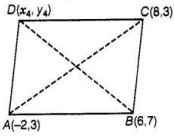
The fourth vertex $D$ of a parallelogram $ABCD$ whose three vertices are $A(-2,3)$,$B(6,7)$,and $C(8,3)$ is
A
$(0,1)$
B
$(0,-1)$
C
$(-1,0)$
D
$(1,0)$
Solution
(B) Let the fourth vertex of the parallelogram be $D(x_4, y_4)$.
In a parallelogram,the diagonals bisect each other,which means the midpoint of diagonal $AC$ is the same as the midpoint of diagonal $BD$.
The midpoint formula for a line segment with endpoints $(x_1, y_1)$ and $(x_2, y_2)$ is $\left(\frac{x_1+x_2}{2}, \frac{y_1+y_2}{2}\right)$.
Midpoint of $AC = \left(\frac{-2+8}{2}, \frac{3+3}{2}\right) = \left(\frac{6}{2}, \frac{6}{2}\right) = (3,3)$.
Midpoint of $BD = \left(\frac{6+x_4}{2}, \frac{7+y_4}{2}\right)$.
Since the midpoints are equal:
$\frac{6+x_4}{2} = 3 \Rightarrow 6+x_4 = 6 \Rightarrow x_4 = 0$.
$\frac{7+y_4}{2} = 3 \Rightarrow 7+y_4 = 6 \Rightarrow y_4 = -1$.
Thus,the fourth vertex $D$ is $(0,-1)$.
0 likes
View Solution9
DifficultMCQ
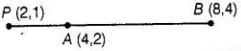
If the point $P (2,1)$ lies on the line segment joining points $A (4,2)$ and $B (8,4)$,then:
A
$AP = \frac{1}{3} AB$
B
$AP = PB$
C
$AP = \frac{1}{2} AB$
D
$PB = \frac{1}{3} AB$
Solution
(C) Given that the point $P(2,1)$ lies on the line segment joining the points $A(4,2)$ and $B(8,4)$.
First,we calculate the distance between $A(4,2)$ and $P(2,1)$ using the distance formula $d = \sqrt{(x_2 - x_1)^2 + (y_2 - y_1)^2}$:
$AP = \sqrt{(2 - 4)^2 + (1 - 2)^2} = \sqrt{(-2)^2 + (-1)^2} = \sqrt{4 + 1} = \sqrt{5}$.
Next,we calculate the distance between $A(4,2)$ and $B(8,4)$:
$AB = \sqrt{(8 - 4)^2 + (4 - 2)^2} = \sqrt{4^2 + 2^2} = \sqrt{16 + 4} = \sqrt{20} = 2\sqrt{5}$.
Now,we compare $AP$ and $AB$:
$AB = 2\sqrt{5} = 2 \times (\sqrt{5}) = 2 AP$.
Therefore,$AP = \frac{1}{2} AB$.
Thus,the correct condition is $AP = \frac{1}{2} AB$.
0 likes
View Solution10
MediumMCQ
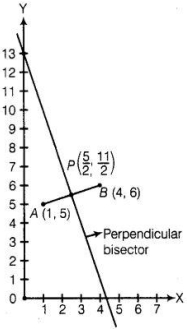
The perpendicular bisector of the line segment joining the points $A(1, 5)$ and $B(4, 6)$ cuts the $y$-axis at
A
$(0, 13)$
B
$(0, -13)$
C
$(0, 12)$
D
$(13, 0)$
Solution
(A) $1$. Find the midpoint $P$ of the line segment $AB$:
$P = \left( \frac{1+4}{2}, \frac{5+6}{2} \right) = \left( \frac{5}{2}, \frac{11}{2} \right)$
$2$. Find the slope of the line segment $AB$ $(m_{AB})$:
$m_{AB} = \frac{6-5}{4-1} = \frac{1}{3}$
$3$. The slope of the perpendicular bisector $(m_{\perp})$ is the negative reciprocal of $m_{AB}$:
$m_{\perp} = -\frac{1}{m_{AB}} = -3$
$4$. Use the point-slope form to find the equation of the perpendicular bisector:
$y - y_1 = m_{\perp}(x - x_1)$
$y - \frac{11}{2} = -3(x - \frac{5}{2})$
$y - \frac{11}{2} = -3x + \frac{15}{2}$
$y = -3x + \frac{15}{2} + \frac{11}{2}$
$y = -3x + \frac{26}{2}$
$y = -3x + 13$
$5$. To find where it cuts the $y$-axis,set $x = 0$:
$y = -3(0) + 13 = 13$
Thus,the perpendicular bisector cuts the $y$-axis at $(0, 13)$.
0 likes
View Solution11
DifficultMCQ
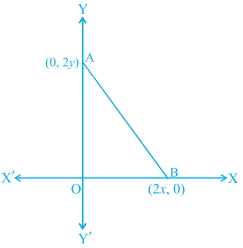
The coordinates of the point which is equidistant from the three vertices of the $\triangle AOB$ as shown in the figure are
A
$(y, x)$
B
$(x, y)$
C
$(\frac{x}{2}, \frac{y}{2})$
D
$(\frac{y}{2}, \frac{x}{2})$
Solution
(B) Let the coordinates of the point $P(h, k)$ be equidistant from the three vertices $O(0, 0)$,$A(0, 2y)$,and $B(2x, 0)$.
Then,$PO = PA = PB$.
$\Rightarrow (PO)^2 = (PA)^2 = (PB)^2$ ..........$(i)$
By the distance formula,we have:
$[\sqrt{(h-0)^2 + (k-0)^2}]^2 = [\sqrt{(h-0)^2 + (k-2y)^2}]^2 = [\sqrt{(h-2x)^2 + (k-0)^2}]^2$
$\Rightarrow h^2 + k^2 = h^2 + (k-2y)^2 = (h-2x)^2 + k^2$
Taking the first two parts:
$h^2 + k^2 = h^2 + (k-2y)^2$
$k^2 = k^2 + 4y^2 - 4yk$
$4y(y - k) = 0 \Rightarrow k = y$ (since $y \neq 0$).
Taking the first and third parts:
$h^2 + k^2 = (h-2x)^2 + k^2$
$h^2 = h^2 + 4x^2 - 4xh$
$4x(x - h) = 0 \Rightarrow h = x$ (since $x \neq 0$).
Therefore,the required point is $(h, k) = (x, y)$.
0 likes
View Solution12
EasyMCQ
The area of a triangle with vertices $(a, b+c), (b, c+a)$ and $(c, a+b)$ is
A
$0$
B
$(a+b+c)^{2}$
C
$(a+b+c)$
D
$abc$
Solution
(A) Let the vertices of the triangle be $A(x_1, y_1) = (a, b+c)$,$B(x_2, y_2) = (b, c+a)$,and $C(x_3, y_3) = (c, a+b)$.
The area of a triangle with vertices $(x_1, y_1), (x_2, y_2), (x_3, y_3)$ is given by the formula:
$\Delta = \frac{1}{2} |x_1(y_2 - y_3) + x_2(y_3 - y_1) + x_3(y_1 - y_2)|$
Substituting the given coordinates into the formula:
$\Delta = \frac{1}{2} |a(c+a - (a+b)) + b(a+b - (b+c)) + c(b+c - (c+a))|$
Simplify the terms inside the brackets:
$\Delta = \frac{1}{2} |a(c-b) + b(a-c) + c(b-a)|$
Expand the terms:
$\Delta = \frac{1}{2} |ac - ab + ab - bc + bc - ac|$
All terms cancel out:
$\Delta = \frac{1}{2} |0| = 0$
Thus,the area of the triangle is $0$.
0 likes
View Solution13
MediumMCQ
If the points $A(1, 2)$,$O(0, 0)$,and $C(a, b)$ are collinear,then:
A
$a = b$
B
$a = 2b$
C
$2a = b$
D
$a = -b$
Solution
(C) Let the given points be $A(x_1, y_1) = (1, 2)$,$O(x_2, y_2) = (0, 0)$,and $C(x_3, y_3) = (a, b)$.
Since the points are collinear,the area of the triangle formed by these points must be zero.
The formula for the area of a triangle is $\Delta = \frac{1}{2} |x_1(y_2 - y_3) + x_2(y_3 - y_1) + x_3(y_1 - y_2)|$.
Substituting the given coordinates:
$0 = \frac{1}{2} |1(0 - b) + 0(b - 2) + a(2 - 0)|$.
$0 = \frac{1}{2} |-b + 0 + 2a|$.
$0 = \frac{1}{2} |2a - b|$.
This implies $2a - b = 0$,or $2a = b$.
Hence,the required relation is $2a = b$.
0 likes
View Solution14
Easy
State whether the following statement is true or false. Justify your answer.
The points $A(-1, 0)$,$B(3, 1)$,$C(2, 2)$,and $D(-2, 1)$ are the vertices of a parallelogram.
The points $A(-1, 0)$,$B(3, 1)$,$C(2, 2)$,and $D(-2, 1)$ are the vertices of a parallelogram.
Solution
(A) The statement is true.
$A$ quadrilateral is a parallelogram if its diagonals bisect each other,which means they share the same midpoint.
$1$. Midpoint of diagonal $AC$:
Midpoint $= (\frac{x_1 + x_2}{2}, \frac{y_1 + y_2}{2}) = (\frac{-1 + 2}{2}, \frac{0 + 2}{2}) = (\frac{1}{2}, 1)$.
$2$. Midpoint of diagonal $BD$:
Midpoint $= (\frac{x_1 + x_2}{2}, \frac{y_1 + y_2}{2}) = (\frac{3 - 2}{2}, \frac{1 + 1}{2}) = (\frac{1}{2}, 1)$.
Since the midpoints of both diagonals $AC$ and $BD$ are the same $(\frac{1}{2}, 1)$,the diagonals bisect each other. Therefore,the points $A, B, C,$ and $D$ form a parallelogram.
0 likes
View Solution15
Medium
State whether the following statement is true or false. Justify your answer.
The points $(4,5), (7,6)$ and $(6,3)$ are collinear.
The points $(4,5), (7,6)$ and $(6,3)$ are collinear.
Solution
(B) False.
To check if the points $A(4,5), B(7,6)$ and $C(6,3)$ are collinear,we calculate the area of the triangle formed by these points using the formula:
Area $= \frac{1}{2} |x_1(y_2 - y_3) + x_2(y_3 - y_1) + x_3(y_1 - y_2)|$
Substituting the values:
Area $= \frac{1}{2} |4(6 - 3) + 7(3 - 5) + 6(5 - 6)|$
Area $= \frac{1}{2} |4(3) + 7(-2) + 6(-1)|$
Area $= \frac{1}{2} |12 - 14 - 6|$
Area $= \frac{1}{2} |-8| = 4 \text{ sq. units}$.
Since the area of the triangle is not $0$,the points are not collinear.
0 likes
View Solution16
Medium
State whether the following statement is true or false. Justify your answer.
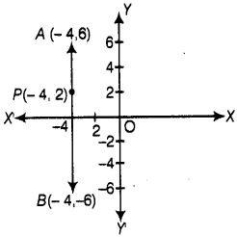
Point $P (-4, 2)$ lies on the line segment joining the points $A (-4, 6)$ and $B (-4, -6)$.
Point $P (-4, 2)$ lies on the line segment joining the points $A (-4, 6)$ and $B (-4, -6)$.
Solution
(TRUE) True.
Analytical Justification:
$1$. The points $A (-4, 6)$ and $B (-4, -6)$ have the same $x$-coordinate,which is $-4$. This means the line segment $AB$ is a vertical line represented by the equation $x = -4$.
$2$. The point $P (-4, 2)$ also has an $x$-coordinate of $-4$,so it lies on the line $x = -4$.
$3$. For $P$ to lie on the line segment $AB$,its $y$-coordinate must be between the $y$-coordinates of $A$ and $B$. The $y$-coordinates of $A$ and $B$ are $6$ and $-6$ respectively.
$4$. Since $-6 < 2 < 6$,the point $P$ lies between $A$ and $B$ on the line segment $AB$.
0 likes
View Solution17
Medium
State whether the following statements are true or false. Justify your answer.
The points $(0,5), (0,-9)$ and $(3,6)$ are collinear.
The points $(0,5), (0,-9)$ and $(3,6)$ are collinear.
Solution
(B) False.
Let the points be $A(0, 5)$,$B(0, -9)$,and $C(3, 6)$.
For points to be collinear,the area of the triangle formed by them must be zero.
The area of a triangle with vertices $(x_{1}, y_{1}), (x_{2}, y_{2})$,and $(x_{3}, y_{3})$ is given by:
$\Delta = \frac{1}{2} |x_{1}(y_{2} - y_{3}) + x_{2}(y_{3} - y_{1}) + x_{3}(y_{1} - y_{2})|$
Substituting the values $x_{1}=0, y_{1}=5, x_{2}=0, y_{2}=-9, x_{3}=3, y_{3}=6$:
$\Delta = \frac{1}{2} |0(-9 - 6) + 0(6 - 5) + 3(5 - (-9))|$
$\Delta = \frac{1}{2} |0 + 0 + 3(5 + 9)|$
$\Delta = \frac{1}{2} |3 \times 14| = \frac{42}{2} = 21$
Since the area of the triangle is $21 \neq 0$,the points are not collinear.
0 likes
View Solution18
Medium
State whether the following statement is true or false. Justify your answer.
Points $A(3, 1)$,$B(12, -2)$,and $C(0, 2)$ cannot be the vertices of a triangle.
Points $A(3, 1)$,$B(12, -2)$,and $C(0, 2)$ cannot be the vertices of a triangle.
Solution
(A) True.
Let the coordinates be $A(x_1, y_1) = (3, 1)$,$B(x_2, y_2) = (12, -2)$,and $C(x_3, y_3) = (0, 2)$.
The area of a triangle with vertices $(x_1, y_1)$,$(x_2, y_2)$,and $(x_3, y_3)$ is given by the formula:
$\text{Area} = \frac{1}{2} |x_1(y_2 - y_3) + x_2(y_3 - y_1) + x_3(y_1 - y_2)|$
Substituting the given values:
$\text{Area} = \frac{1}{2} |3(-2 - 2) + 12(2 - 1) + 0(1 - (-2))|$
$\text{Area} = \frac{1}{2} |3(-4) + 12(1) + 0(3)|$
$\text{Area} = \frac{1}{2} |-12 + 12 + 0|$
$\text{Area} = \frac{1}{2} |0| = 0$
Since the area of the triangle formed by these points is $0$,the points are collinear (they lie on the same straight line).
Therefore,these points cannot form a triangle. Thus,the statement is true.
0 likes
View Solution19
Medium
State whether the following statement is true or false. Justify your answer.
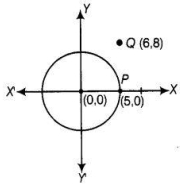
$A$ circle has its centre at the origin and a point $P(5,0)$ lies on it. The point $Q(6,8)$ lies outside the circle.
$A$ circle has its centre at the origin and a point $P(5,0)$ lies on it. The point $Q(6,8)$ lies outside the circle.
Solution
(TRUE) True.
Given that the circle has its centre at the origin $O(0,0)$ and the point $P(5,0)$ lies on the circle.
The radius $r$ of the circle is the distance between the centre $O(0,0)$ and the point $P(5,0)$ on the circle.
Using the distance formula $d = \sqrt{(x_2 - x_1)^2 + (y_2 - y_1)^2}$:
$r = OP = \sqrt{(5 - 0)^2 + (0 - 0)^2} = \sqrt{5^2 + 0^2} = \sqrt{25} = 5$.
Now,we calculate the distance of point $Q(6,8)$ from the centre $O(0,0)$:
$OQ = \sqrt{(6 - 0)^2 + (8 - 0)^2} = \sqrt{6^2 + 8^2} = \sqrt{36 + 64} = \sqrt{100} = 10$.
We know that if the distance of a point from the centre is greater than the radius,the point lies outside the circle.
Since $OQ = 10$ and $r = 5$,we have $OQ > r$.
Therefore,the point $Q(6,8)$ lies outside the circle. Hence,the statement is true.
0 likes
View Solution20
Difficult
State whether the following statement is true or false. Justify your answer.
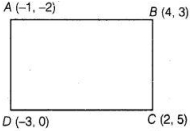
The points $A(-1, -2)$,$B(4, 3)$,$C(2, 5)$,and $D(-3, 0)$ in that order form a rectangle.
The points $A(-1, -2)$,$B(4, 3)$,$C(2, 5)$,and $D(-3, 0)$ in that order form a rectangle.
Solution
(A) True.
Using the distance formula $d = \sqrt{(x_2 - x_1)^2 + (y_2 - y_1)^2}$:
$1$. Length of sides:
$AB = \sqrt{(4 - (-1))^2 + (3 - (-2))^2} = \sqrt{5^2 + 5^2} = \sqrt{25 + 25} = \sqrt{50} = 5\sqrt{2}$
$BC = \sqrt{(2 - 4)^2 + (5 - 3)^2} = \sqrt{(-2)^2 + 2^2} = \sqrt{4 + 4} = \sqrt{8} = 2\sqrt{2}$
$CD = \sqrt{(-3 - 2)^2 + (0 - 5)^2} = \sqrt{(-5)^2 + (-5)^2} = \sqrt{25 + 25} = \sqrt{50} = 5\sqrt{2}$
$DA = \sqrt{(-1 - (-3))^2 + (-2 - 0)^2} = \sqrt{2^2 + (-2)^2} = \sqrt{4 + 4} = \sqrt{8} = 2\sqrt{2}$
Since opposite sides are equal ($AB = CD$ and $BC = DA$),it is a parallelogram.
$2$. Length of diagonals:
$AC = \sqrt{(2 - (-1))^2 + (5 - (-2))^2} = \sqrt{3^2 + 7^2} = \sqrt{9 + 49} = \sqrt{58}$
$BD = \sqrt{(-3 - 4)^2 + (0 - 3)^2} = \sqrt{(-7)^2 + (-3)^2} = \sqrt{49 + 9} = \sqrt{58}$
Since the diagonals are equal $(AC = BD)$,the parallelogram is a rectangle.
0 likes
View Solution21
MediumMCQ
Find the area of the triangle $ABC$ with vertex $A (1, -4)$ and the mid-points of the sides passing through $A$ being $(2, -1)$ and $(0, -1)$ (in $sq. units$).
A
$18$
B
$6$
C
$19$
D
$12$
Solution
(D) Let the coordinates of vertices $B$ and $C$ be $(a, b)$ and $(x, y)$ respectively.
The mid-point of side $AB$ is given as $(2, -1)$. Thus,$\left(\frac{1+a}{2}, \frac{-4+b}{2}\right) = (2, -1)$.
Equating the coordinates,we get $1+a = 4 \implies a = 3$ and $-4+b = -2 \implies b = 2$. So,$B = (3, 2)$.
The mid-point of side $AC$ is given as $(0, -1)$. Thus,$\left(\frac{1+x}{2}, \frac{-4+y}{2}\right) = (0, -1)$.
Equating the coordinates,we get $1+x = 0 \implies x = -1$ and $-4+y = -2 \implies y = 2$. So,$C = (-1, 2)$.
The vertices of $\triangle ABC$ are $A(1, -4)$,$B(3, 2)$,and $C(-1, 2)$.
The area of $\triangle ABC = \frac{1}{2} |x_1(y_2 - y_3) + x_2(y_3 - y_1) + x_3(y_1 - y_2)|$.
Area $= \frac{1}{2} |1(2 - 2) + 3(2 - (-4)) + (-1)(-4 - 2)|$.
Area $= \frac{1}{2} |0 + 3(6) - 1(-6)| = \frac{1}{2} |18 + 6| = \frac{24}{2} = 12$ $sq. units$.
0 likes
View Solution22
MediumMCQ
Find the area of the triangle whose vertices are (in square units): $(-5,-1), (3,-5), (5,2)$.
A
$30$
B
$32$
C
$28$
D
$22$
Solution
(B) The area of a triangle with vertices $(x_1, y_1), (x_2, y_2),$ and $(x_3, y_3)$ is given by the formula:
Area $= \frac{1}{2} |x_1(y_2 - y_3) + x_2(y_3 - y_1) + x_3(y_1 - y_2)|$
Given vertices are $(x_1, y_1) = (-5, -1)$,$(x_2, y_2) = (3, -5)$,and $(x_3, y_3) = (5, 2)$.
Substituting these values into the formula:
Area $= \frac{1}{2} |(-5)(-5 - 2) + 3(2 - (-1)) + 5(-1 - (-5))|$
Area $= \frac{1}{2} |(-5)(-7) + 3(3) + 5(4)|$
Area $= \frac{1}{2} |35 + 9 + 20|$
Area $= \frac{1}{2} |64| = 32$ square units.
0 likes
View Solution23
MediumMCQ
In each of the following,find the value of $k$ for which the points are collinear: $(7, -2), (5, 1), (3, k)$.
A
$1$
B
$4$
C
$10$
D
$8$
Solution
(B) For points to be collinear,the area of the triangle formed by them must be equal to $0$.
The formula for the area of a triangle with vertices $(x_1, y_1), (x_2, y_2),$ and $(x_3, y_3)$ is $\frac{1}{2} |x_1(y_2 - y_3) + x_2(y_3 - y_1) + x_3(y_1 - y_2)| = 0$.
Substituting the given points $(7, -2), (5, 1),$ and $(3, k)$ into the formula:
$\frac{1}{2} |7(1 - k) + 5(k - (-2)) + 3(-2 - 1)| = 0$
$\frac{1}{2} |7 - 7k + 5(k + 2) + 3(-3)| = 0$
$\frac{1}{2} |7 - 7k + 5k + 10 - 9| = 0$
$|8 - 2k| = 0$
$8 - 2k = 0$
$2k = 8$
$k = 4$
0 likes
View Solution24
MediumMCQ
Find the value of $k$ for which the points $(8,1), (k,-4),$ and $(2,-5)$ are collinear.
A
$7$
B
$8$
C
$3$
D
$11$
Solution
(C) For points to be collinear,the area of the triangle formed by them must be $0$.
The area of a triangle with vertices $(x_1, y_1), (x_2, y_2),$ and $(x_3, y_3)$ is given by $\frac{1}{2} |x_1(y_2 - y_3) + x_2(y_3 - y_1) + x_3(y_1 - y_2)| = 0$.
Substituting the given points $(8,1), (k,-4),$ and $(2,-5)$ into the formula:
$\frac{1}{2} |8(-4 - (-5)) + k(-5 - 1) + 2(1 - (-4))| = 0$
$\frac{1}{2} |8(-4 + 5) + k(-6) + 2(1 + 4)| = 0$
$\frac{1}{2} |8(1) - 6k + 2(5)| = 0$
$|8 - 6k + 10| = 0$
$18 - 6k = 0$
$6k = 18$
$k = 3$
0 likes
View Solution25
Medium
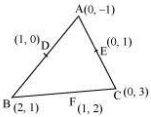
Find the area of the triangle formed by joining the mid-points of the sides of the triangle whose vertices are $(0,-1), (2,1)$ and $(0,3)$. Find the ratio of this area to the area of the given triangle.
Solution
(1:4) Let the vertices of the triangle be $A(0,-1), B(2,1), C(0,3)$.
Let $D, E, F$ be the mid-points of the sides $AB, AC, BC$ respectively. The coordinates of $D, E,$ and $F$ are calculated using the mid-point formula:
$D = \left(\frac{0+2}{2}, \frac{-1+1}{2}\right) = (1,0)$
$E = \left(\frac{0+0}{2}, \frac{-1+3}{2}\right) = (0,1)$
$F = \left(\frac{2+0}{2}, \frac{1+3}{2}\right) = (1,2)$
The area of a triangle with vertices $(x_1, y_1), (x_2, y_2), (x_3, y_3)$ is given by $\frac{1}{2} |x_1(y_2-y_3) + x_2(y_3-y_1) + x_3(y_1-y_2)|$.
Area of $\Delta DEF = \frac{1}{2} |1(1-2) + 0(2-0) + 1(0-1)| = \frac{1}{2} |-1 + 0 - 1| = \frac{1}{2} |-2| = 1$ square unit.
Area of $\Delta ABC = \frac{1}{2} |0(1-3) + 2(3-(-1)) + 0(-1-1)| = \frac{1}{2} |0 + 2(4) + 0| = \frac{1}{2} |8| = 4$ square units.
Therefore,the required ratio is $1:4$.
0 likes
View Solution26
MediumMCQ
Find the area of the quadrilateral whose vertices,taken in order,are $(-4,-2), (-3,-5), (3,-2),$ and $(2,3)$ (in square units).
A
$32$
B
$28$
C
$22$
D
$12$
Solution
(B) Let the vertices of the quadrilateral be $A(-4,-2), B(-3,-5), C(3,-2),$ and $D(2,3)$. Join $AC$ to form two triangles $\triangle ABC$ and $\triangle ACD$.
Area of a triangle $= \frac{1}{2} |x_{1}(y_{2}-y_{3}) + x_{2}(y_{3}-y_{1}) + x_{3}(y_{1}-y_{2})|$
Area of $\triangle ABC = \frac{1}{2} |(-4){(-5)-(-2)} + (-3){(-2)-(-2)} + 3{(-2)-(-5)}|$
$= \frac{1}{2} |(-4)(-3) + (-3)(0) + 3(3)| = \frac{1}{2} |12 + 0 + 9| = \frac{21}{2} = 10.5$ square units.
Area of $\triangle ACD = \frac{1}{2} |(-4){(-2)-(3)} + 3{(3)-(-2)} + 2{(-2)-(-2)}|$
$= \frac{1}{2} |(-4)(-5) + 3(5) + 2(0)| = \frac{1}{2} |20 + 15 + 0| = \frac{35}{2} = 17.5$ square units.
Area of quadrilateral $ABCD = \text{Area of } \triangle ABC + \text{Area of } \triangle ACD$
$= 10.5 + 17.5 = 28$ square units.
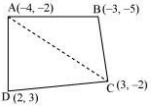
0 likes
View Solution27
MediumMCQ
$A$ median of a triangle divides it into two triangles of equal areas. Verify this result for $\Delta ABC$ whose vertices are $A (4, -6), B (3, -2)$ and $C (5, 2)$. Find the area of each triangle (in square units).
A
$9$
B
$1$
C
$3$
D
$7$
Solution
(C) Let the vertices of the triangle be $A (4, -6), B (3, -2),$ and $C (5, 2)$.
Let $D$ be the mid-point of side $BC$ of $\triangle ABC$. Therefore,$AD$ is the median of $\triangle ABC$.
Coordinates of point $D = \left(\frac{3+5}{2}, \frac{-2+2}{2}\right) = (4, 0)$.
The area of a triangle with vertices $(x_1, y_1), (x_2, y_2),$ and $(x_3, y_3)$ is given by $\frac{1}{2} |x_1(y_2 - y_3) + x_2(y_3 - y_1) + x_3(y_1 - y_2)|$.
Area of $\triangle ABD = \frac{1}{2} |4(-2 - 0) + 3(0 - (-6)) + 4(-6 - (-2))|$
$= \frac{1}{2} |4(-2) + 3(6) + 4(-4)|$
$= \frac{1}{2} |-8 + 18 - 16| = \frac{1}{2} |-6| = 3$ square units.
Area of $\triangle ADC = \frac{1}{2} |4(0 - 2) + 4(2 - (-6)) + 5(-6 - 0)|$
$= \frac{1}{2} |4(-2) + 4(8) + 5(-6)|$
$= \frac{1}{2} |-8 + 32 - 30| = \frac{1}{2} |-6| = 3$ square units.
Since the area of $\triangle ABD = \text{Area of } \triangle ADC = 3$ square units,the median $AD$ divides $\triangle ABC$ into two triangles of equal areas.
0 likes
View Solution28
Easy
Find a relation between $x$ and $y$ if the points $(x, y), (1, 2)$ and $(7, 0)$ are collinear.
Solution
(N/A) If the given points are collinear,then the area of the triangle formed by these points must be $0$.
The area of a triangle with vertices $(x_1, y_1), (x_2, y_2)$ and $(x_3, y_3)$ is given by the formula:
Area $= \frac{1}{2} |x_1(y_2 - y_3) + x_2(y_3 - y_1) + x_3(y_1 - y_2)|$
Substituting the given points $(x, y), (1, 2)$ and $(7, 0)$ into the formula:
$0 = \frac{1}{2} |x(2 - 0) + 1(0 - y) + 7(y - 2)|$
$0 = \frac{1}{2} |2x - y + 7y - 14|$
$0 = \frac{1}{2} |2x + 6y - 14|$
Multiplying by $2$ on both sides:
$2x + 6y - 14 = 0$
Dividing the entire equation by $2$:
$x + 3y - 7 = 0$
Thus,the required relation between $x$ and $y$ is $x + 3y - 7 = 0$.
0 likes
View Solution29
Medium
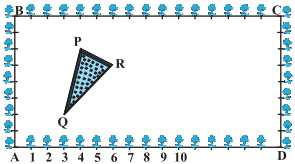
The Class $X$ students of a secondary school in Krishinagar have been allotted a rectangular plot of land for their gardening activity. Saplings of Gulmohar are planted on the boundary at a distance of $1\, m$ from each other. There is a triangular grassy lawn in the plot as shown in the Figure. The students are to sow seeds of flowering plants on the remaining area of the plot.
What will be the coordinates of the vertices of $\Delta PQR$ if $C$ is the origin?
Also,calculate the area of the triangle in this case.
What will be the coordinates of the vertices of $\Delta PQR$ if $C$ is the origin?
Also,calculate the area of the triangle in this case.
Solution
(N/A) Taking $C$ as the origin $(0,0)$,$CB$ as the $x$-axis,and $CD$ as the $y$-axis:
$1$. The coordinates of the vertices are determined by counting the units from the origin $C$ along the axes.
$2$. The coordinates of the vertices $P, Q,$ and $R$ are $P(12, 2), Q(13, 6),$ and $R(10, 3)$.
$3$. The area of a triangle with vertices $(x_1, y_1), (x_2, y_2),$ and $(x_3, y_3)$ is given by:
$\text{Area} = \frac{1}{2} |x_1(y_2 - y_3) + x_2(y_3 - y_1) + x_3(y_1 - y_2)|$
$4$. Substituting the values:
$\text{Area} = \frac{1}{2} |12(6 - 3) + 13(3 - 2) + 10(2 - 6)|$
$\text{Area} = \frac{1}{2} |12(3) + 13(1) + 10(-4)|$
$\text{Area} = \frac{1}{2} |36 + 13 - 40|$
$\text{Area} = \frac{1}{2} |9| = 4.5 \text{ square units}$.
0 likes
View Solution30
Difficult
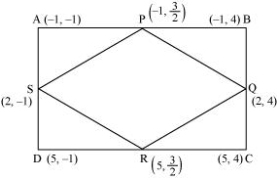
$ABCD$ is a rectangle formed by the points $A(-1, -1)$,$B(-1, 4)$,$C(5, 4)$,and $D(5, -1)$. $P, Q, R$,and $S$ are the mid-points of $AB, BC, CD$,and $DA$ respectively. Is the quadrilateral $PQRS$ a square,a rectangle,or a rhombus? Justify your answer.
Solution
(C) $P$ is the mid-point of side $AB$. Therefore,the coordinates of $P$ are $\left(\frac{-1-1}{2}, \frac{-1+4}{2}\right) = \left(-1, \frac{3}{2}\right)$.
Similarly,the coordinates of $Q, R$,and $S$ are $(2, 4)$,$\left(5, \frac{3}{2}\right)$,and $(2, -1)$ respectively.
Length of $PQ = \sqrt{(-1-2)^2 + \left(\frac{3}{2}-4\right)^2} = \sqrt{(-3)^2 + \left(-\frac{5}{2}\right)^2} = \sqrt{9 + \frac{25}{4}} = \sqrt{\frac{61}{4}}$.
Length of $QR = \sqrt{(2-5)^2 + \left(4-\frac{3}{2}\right)^2} = \sqrt{(-3)^2 + \left(\frac{5}{2}\right)^2} = \sqrt{9 + \frac{25}{4}} = \sqrt{\frac{61}{4}}$.
Length of $RS = \sqrt{(5-2)^2 + \left(\frac{3}{2}-(-1)\right)^2} = \sqrt{3^2 + \left(\frac{5}{2}\right)^2} = \sqrt{9 + \frac{25}{4}} = \sqrt{\frac{61}{4}}$.
Length of $SP = \sqrt{(2-(-1))^2 + \left(-1-\frac{3}{2}\right)^2} = \sqrt{3^2 + \left(-\frac{5}{2}\right)^2} = \sqrt{9 + \frac{25}{4}} = \sqrt{\frac{61}{4}}$.
Length of diagonal $PR = \sqrt{(-1-5)^2 + \left(\frac{3}{2}-\frac{3}{2}\right)^2} = \sqrt{(-6)^2 + 0^2} = 6$.
Length of diagonal $QS = \sqrt{(2-2)^2 + (4-(-1))^2} = \sqrt{0^2 + 5^2} = 5$.
Since all sides are equal $(PQ = QR = RS = SP = \sqrt{\frac{61}{4}})$ and the diagonals are not equal $(PR \neq QS)$,the quadrilateral $PQRS$ is a rhombus.
0 likes
View Solution31
Medium
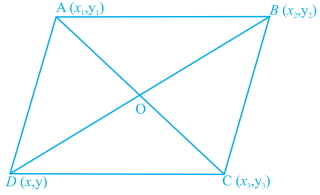
$ABCD$ is a parallelogram with vertices $A(x_{1}, y_{1})$,$B(x_{2}, y_{2})$,and $C(x_{3}, y_{3})$. Find the coordinates of the fourth vertex $D$ in terms of $x_{1}, x_{2}, x_{3}, y_{1}, y_{2}$,and $y_{3}$.
Solution
(N/A) Let the coordinates of vertex $D$ be $(x, y)$.
We know that the diagonals of a parallelogram bisect each other at their midpoint.
Therefore,the midpoint of diagonal $AC$ is equal to the midpoint of diagonal $BD$.
The midpoint of $AC$ is given by $\left(\frac{x_{1}+x_{3}}{2}, \frac{y_{1}+y_{3}}{2}\right)$.
The midpoint of $BD$ is given by $\left(\frac{x_{2}+x}{2}, \frac{y_{2}+y}{2}\right)$.
Equating the coordinates,we get:
$\frac{x_{1}+x_{3}}{2} = \frac{x_{2}+x}{2} \implies x_{1}+x_{3} = x_{2}+x \implies x = x_{1}+x_{3}-x_{2}$.
$\frac{y_{1}+y_{3}}{2} = \frac{y_{2}+y}{2} \implies y_{1}+y_{3} = y_{2}+y \implies y = y_{1}+y_{3}-y_{2}$.
Thus,the coordinates of vertex $D$ are $(x_{1}+x_{3}-x_{2}, y_{1}+y_{3}-y_{2})$.
0 likes
View Solution32
MediumMCQ
What type of a quadrilateral do the points $A(2, -2)$,$B(7, 3)$,$C(11, -1)$,and $D(6, -6)$ taken in that order,form?
A
Square
B
Rectangle
C
Rhombus
D
Parallelogram
Solution
(B) To determine the type of quadrilateral,we calculate the lengths of all four sides and the two diagonals using the distance formula: $d = \sqrt{(x_2 - x_1)^2 + (y_2 - y_1)^2}$.
Sides:
$AB = \sqrt{(7 - 2)^2 + (3 - (-2))^2} = \sqrt{5^2 + 5^2} = \sqrt{25 + 25} = \sqrt{50} = 5\sqrt{2}$
$BC = \sqrt{(11 - 7)^2 + (-1 - 3)^2} = \sqrt{4^2 + (-4)^2} = \sqrt{16 + 16} = \sqrt{32} = 4\sqrt{2}$
$CD = \sqrt{(6 - 11)^2 + (-6 - (-1))^2} = \sqrt{(-5)^2 + (-5)^2} = \sqrt{25 + 25} = \sqrt{50} = 5\sqrt{2}$
$DA = \sqrt{(2 - 6)^2 + (-2 - (-6))^2} = \sqrt{(-4)^2 + 4^2} = \sqrt{16 + 16} = \sqrt{32} = 4\sqrt{2}$
Diagonals:
$AC = \sqrt{(11 - 2)^2 + (-1 - (-2))^2} = \sqrt{9^2 + 1^2} = \sqrt{81 + 1} = \sqrt{82}$
$BD = \sqrt{(6 - 7)^2 + (-6 - 3)^2} = \sqrt{(-1)^2 + (-9)^2} = \sqrt{1 + 81} = \sqrt{82}$
Since opposite sides are equal ($AB = CD$ and $BC = DA$) and the diagonals are equal $(AC = BD)$,the quadrilateral is a rectangle.
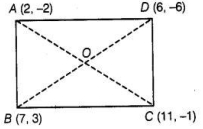
0 likes
View Solution33
Difficult
Find the coordinates of the point $Q$ on the $x$-axis which lies on the perpendicular bisector of the line segment joining the points $A(-5, -2)$ and $B(4, -2)$. Name the type of triangle formed by the points $Q, A$ and $B$.
Solution
(N/A) The points are $A(-5, -2)$ and $B(4, -2)$.
Since the $y$-coordinates of both points are the same $(-2)$,the line segment $AB$ is a horizontal line parallel to the $x$-axis.
The perpendicular bisector of a horizontal line is a vertical line passing through the midpoint of the segment.
The midpoint $R$ of $AB$ is given by $\left(\frac{-5+4}{2}, \frac{-2-2}{2}\right) = \left(-\frac{1}{2}, -2\right)$.
The perpendicular bisector is the vertical line $x = -\frac{1}{2}$.
The point $Q$ lies on the $x$-axis,so its $y$-coordinate is $0$. Since it lies on the perpendicular bisector $x = -\frac{1}{2}$,the coordinates of $Q$ are $\left(-\frac{1}{2}, 0\right)$.
To identify the triangle $QAB$,we calculate the lengths of the sides:
$AB = \sqrt{(4 - (-5))^2 + (-2 - (-2))^2} = \sqrt{9^2 + 0^2} = 9$.
$QA = \sqrt{(-5 - (-0.5))^2 + (-2 - 0)^2} = \sqrt{(-4.5)^2 + (-2)^2} = \sqrt{20.25 + 4} = \sqrt{24.25}$.
$QB = \sqrt{(4 - (-0.5))^2 + (-2 - 0)^2} = \sqrt{(4.5)^2 + (-2)^2} = \sqrt{20.25 + 4} = \sqrt{24.25}$.
Since $QA = QB$,the triangle $QAB$ is an isosceles triangle.
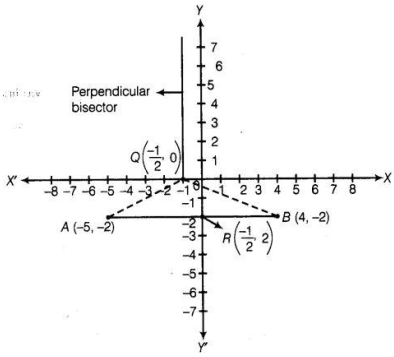
0 likes
View Solution34
MediumMCQ
Find the value of $m$ if the points $(5,1), (-2,-3)$ and $(8,2m)$ are collinear.
A
$\frac{19}{14}$
B
$\frac{17}{14}$
C
$\frac{19}{17}$
D
$\frac{14}{19}$
Solution
(A) Let the points be $A(5, 1)$,$B(-2, -3)$,and $C(8, 2m)$.
Since the points are collinear,the area of the triangle formed by them must be $0$.
The formula for the area of a triangle with vertices $(x_1, y_1)$,$(x_2, y_2)$,and $(x_3, y_3)$ is $\frac{1}{2} |x_1(y_2 - y_3) + x_2(y_3 - y_1) + x_3(y_1 - y_2)| = 0$.
Substituting the given coordinates:
$\frac{1}{2} |5(-3 - 2m) + (-2)(2m - 1) + 8(1 - (-3))| = 0$
$5(-3 - 2m) - 2(2m - 1) + 8(4) = 0$
$-15 - 10m - 4m + 2 + 32 = 0$
$-14m + 19 = 0$
$14m = 19$
$m = \frac{19}{14}$
0 likes
View Solution35
EasyMCQ
Find the area of the triangle whose vertices are $(-8, 4), (-6, 6)$ and $(-3, 9).$
A
$1$
B
$-1$
C
$0$
D
$-2$
Solution
(C) Given the vertices of the triangle are $(x_1, y_1) = (-8, 4)$,$(x_2, y_2) = (-6, 6)$,and $(x_3, y_3) = (-3, 9)$.
The formula for the area of a triangle with vertices $(x_1, y_1), (x_2, y_2),$ and $(x_3, y_3)$ is:
$\text{Area} = \frac{1}{2} |x_1(y_2 - y_3) + x_2(y_3 - y_1) + x_3(y_1 - y_2)|$
Substituting the given values into the formula:
$\text{Area} = \frac{1}{2} |-8(6 - 9) + (-6)(9 - 4) + (-3)(4 - 6)|$
$= \frac{1}{2} |-8(-3) - 6(5) - 3(-2)|$
$= \frac{1}{2} |24 - 30 + 6|$
$= \frac{1}{2} |30 - 30| = \frac{1}{2}(0) = 0$
Since the area is $0$,the points are collinear,and the area of the triangle formed by them is $0$.
0 likes
View Solution36
Difficult
If $(a, b)$ is the mid-point of the line segment joining the points $A (10, -6)$ and $B (k, 4)$ and $a - 2b = 18$,find the value of $k$ and the distance $AB$.
Solution
(D) Since $(a, b)$ is the mid-point of the line segment $AB$,we use the mid-point formula:
$(a, b) = \left(\frac{10 + k}{2}, \frac{-6 + 4}{2}\right)$
$(a, b) = \left(\frac{10 + k}{2}, -1\right)$
Equating the coordinates,we get:
$a = \frac{10 + k}{2}$ ... $(i)$
$b = -1$ ... $(ii)$
Given the equation $a - 2b = 18$,substitute $b = -1$:
$a - 2(-1) = 18$
$a + 2 = 18 \Rightarrow a = 16$
Now,substitute $a = 16$ into equation $(i)$:
$16 = \frac{10 + k}{2}$
$32 = 10 + k \Rightarrow k = 22$
Thus,the coordinates of $B$ are $(22, 4)$.
Now,calculate the distance $AB$ using the distance formula:
$AB = \sqrt{(22 - 10)^2 + (4 - (-6))^2}$
$AB = \sqrt{(12)^2 + (10)^2}$
$AB = \sqrt{144 + 100} = \sqrt{244}$
$AB = 2\sqrt{61}$ units.
0 likes
View Solution37
Difficult
The centre of a circle is $(2a, a-7)$. Find the values of $a$ if the circle passes through the point $(11, -9)$ and has a diameter of $10\sqrt{2}$ units.
Solution
(A-D) Given that the centre of the circle is $C(2a, a-7)$ and it passes through the point $P(11, -9)$.
The distance between the centre $C$ and the point $P$ on the circle is equal to the radius $r$.
Using the distance formula,$r = \sqrt{(11 - 2a)^2 + (-9 - (a - 7))^2} = \sqrt{(11 - 2a)^2 + (-2 - a)^2}$.
The diameter of the circle is $10\sqrt{2}$ units,so the radius $r = \frac{10\sqrt{2}}{2} = 5\sqrt{2}$ units.
Equating the two expressions for the radius:
$5\sqrt{2} = \sqrt{(11 - 2a)^2 + (-2 - a)^2}$.
Squaring both sides:
$(5\sqrt{2})^2 = (11 - 2a)^2 + (-2 - a)^2$
$50 = (121 - 44a + 4a^2) + (4 + 4a + a^2)$
$50 = 5a^2 - 40a + 125$
$5a^2 - 40a + 75 = 0$.
Dividing by $5$:
$a^2 - 8a + 15 = 0$
$a^2 - 5a - 3a + 15 = 0$
$a(a - 5) - 3(a - 5) = 0$
$(a - 5)(a - 3) = 0$.
Therefore,the values of $a$ are $a = 5$ or $a = 3$.
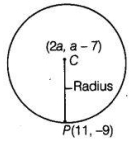
0 likes
View Solution38
DifficultMCQ
If $D\left(\frac{-1}{2}, \frac{5}{2}\right)$,$E(7, 3)$,and $F\left(\frac{7}{2}, \frac{7}{2}\right)$ are the midpoints of the sides of $\triangle ABC$,find the area of $\triangle ABC$.
A
$10$
B
$11$
C
$12$
D
$13$
Solution
(B) Let $A=(x_1, y_1)$,$B=(x_2, y_2)$,and $C=(x_3, y_3)$ be the vertices of $\triangle ABC$.
Given that $D\left(-\frac{1}{2}, \frac{5}{2}\right)$,$E(7, 3)$,and $F\left(\frac{7}{2}, \frac{7}{2}\right)$ are the midpoints of sides $BC$,$CA$,and $AB$ respectively.
Using the midpoint formula,we have:
For $BC$: $\frac{x_2+x_3}{2} = -\frac{1}{2} \Rightarrow x_2+x_3 = -1$ $(i)$ and $\frac{y_2+y_3}{2} = \frac{5}{2} \Rightarrow y_2+y_3 = 5$ $(ii)$.
For $CA$: $\frac{x_3+x_1}{2} = 7 \Rightarrow x_3+x_1 = 14$ $(iii)$ and $\frac{y_3+y_1}{2} = 3 \Rightarrow y_3+y_1 = 6$ $(iv)$.
For $AB$: $\frac{x_1+x_2}{2} = \frac{7}{2} \Rightarrow x_1+x_2 = 7$ $(v)$ and $\frac{y_1+y_2}{2} = \frac{7}{2} \Rightarrow y_1+y_2 = 7$ $(vi)$.
Adding $(i), (iii), (v)$: $2(x_1+x_2+x_3) = 20 \Rightarrow x_1+x_2+x_3 = 10$ $(vii)$.
Subtracting $(i), (iii), (v)$ from $(vii)$ gives $x_1=11, x_2=-4, x_3=3$.
Adding $(ii), (iv), (vi)$: $2(y_1+y_2+y_3) = 18 \Rightarrow y_1+y_2+y_3 = 9$ $(viii)$.
Subtracting $(ii), (iv), (vi)$ from $(viii)$ gives $y_1=4, y_2=3, y_3=2$.
Vertices are $A(11, 4), B(-4, 3), C(3, 2)$.
Area $= \frac{1}{2} |x_1(y_2-y_3) + x_2(y_3-y_1) + x_3(y_1-y_2)|$
$= \frac{1}{2} |11(3-2) + (-4)(2-4) + 3(4-3)| = \frac{1}{2} |11(1) + (-4)(-2) + 3(1)| = \frac{1}{2} |11+8+3| = \frac{22}{2} = 11$ sq units.
0 likes
View Solution39
Difficult
The points $A(2, 9)$,$B(a, 5)$,and $C(5, 5)$ are the vertices of a triangle $ABC$ right-angled at $B$. Find the value of $a$ and the area of $\triangle ABC$.
Solution
(A) Given that the points $A(2, 9)$,$B(a, 5)$,and $C(5, 5)$ are the vertices of a $\triangle ABC$ right-angled at $B$.
By the Pythagoras theorem,$AC^2 = AB^2 + BC^2$ $(i)$.
Using the distance formula $d = \sqrt{(x_2 - x_1)^2 + (y_2 - y_1)^2}$:
$AB = \sqrt{(a - 2)^2 + (5 - 9)^2} = \sqrt{a^2 - 4a + 4 + 16} = \sqrt{a^2 - 4a + 20}$.
$BC = \sqrt{(5 - a)^2 + (5 - 5)^2} = \sqrt{(5 - a)^2} = |5 - a|$.
$AC = \sqrt{(5 - 2)^2 + (5 - 9)^2} = \sqrt{3^2 + (-4)^2} = \sqrt{9 + 16} = 5$.
Substituting these into $(i)$:
$5^2 = (\sqrt{a^2 - 4a + 20})^2 + (5 - a)^2$.
$25 = a^2 - 4a + 20 + 25 - 10a + a^2$.
$2a^2 - 14a + 20 = 0$.
$a^2 - 7a + 10 = 0$.
$(a - 2)(a - 5) = 0$.
So,$a = 2$ or $a = 5$.
If $a = 5$,then $B$ coincides with $C$,which is not possible for a triangle. Thus,$a = 2$.
With $a = 2$,the vertices are $A(2, 9)$,$B(2, 5)$,and $C(5, 5)$.
Area of $\triangle ABC = \frac{1}{2} \times \text{base} \times \text{height} = \frac{1}{2} \times BC \times AB$.
$BC = |5 - 2| = 3$ units.
$AB = |9 - 5| = 4$ units.
Area $= \frac{1}{2} \times 3 \times 4 = 6$ sq units.
0 likes
View Solution40
DifficultMCQ
Find the values of $k$ if the points $A(k+1, 2k)$,$B(3k, 2k+3)$ and $C(5k-1, 5k)$ are collinear.
A
$2, \frac{1}{2}$
B
$3, \frac{1}{3}$
C
$4, \frac{1}{4}$
D
$6, \frac{1}{6}$
Solution
(A) We know that if three points are collinear,the area of the triangle formed by these points is zero.
Since the points $A(k+1, 2k)$,$B(3k, 2k+3)$,and $C(5k-1, 5k)$ are collinear,the area of $\triangle ABC = 0$.
The formula for the area of a triangle is $\frac{1}{2} |x_1(y_2 - y_3) + x_2(y_3 - y_1) + x_3(y_1 - y_2)| = 0$.
Here,$x_1 = k+1, x_2 = 3k, x_3 = 5k-1$ and $y_1 = 2k, y_2 = 2k+3, y_3 = 5k$.
Substituting these values:
$\frac{1}{2} [(k+1)(2k+3 - 5k) + 3k(5k - 2k) + (5k-1)(2k - (2k+3))] = 0$
$\frac{1}{2} [(k+1)(-3k+3) + 3k(3k) + (5k-1)(-3)] = 0$
$(-3k^2 + 3k - 3k + 3) + 9k^2 - 15k + 3 = 0$
$6k^2 - 15k + 6 = 0$
Dividing by $3$,we get $2k^2 - 5k + 2 = 0$.
Factoring the quadratic equation: $2k^2 - 4k - k + 2 = 0 \Rightarrow 2k(k-2) - 1(k-2) = 0$.
$(k-2)(2k-1) = 0$.
Thus,$k = 2$ or $k = \frac{1}{2}$.
0 likes
View Solution41
Medium
The mid-points $D, E, F$ of the sides of a triangle $ABC$ are $(3, 4), (8, 9),$ and $(6, 7)$ respectively. Find the coordinates of the vertices of the triangle.
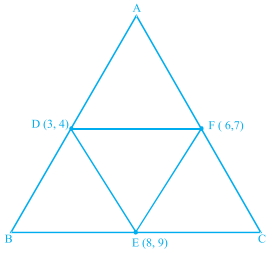
Solution
(N/A) Let the vertices of the triangle be $A(x_1, y_1), B(x_2, y_2),$ and $C(x_3, y_3).$ The mid-points are given as $D(3, 4)$ on $AB,$ $E(8, 9)$ on $BC,$ and $F(6, 7)$ on $AC.$
Using the mid-point formula:
$1) \frac{x_1 + x_2}{2} = 3, \frac{y_1 + y_2}{2} = 4 \implies x_1 + x_2 = 6, y_1 + y_2 = 8$
$2) \frac{x_2 + x_3}{2} = 8, \frac{y_2 + y_3}{2} = 9 \implies x_2 + x_3 = 16, y_2 + y_3 = 18$
$3) \frac{x_1 + x_3}{2} = 6, \frac{y_1 + y_3}{2} = 7 \implies x_1 + x_3 = 12, y_1 + y_3 = 14$
Adding these equations:
$(x_1 + x_2) + (x_2 + x_3) + (x_1 + x_3) = 6 + 16 + 12 = 34 \implies 2(x_1 + x_2 + x_3) = 34 \implies x_1 + x_2 + x_3 = 17$
$(y_1 + y_2) + (y_2 + y_3) + (y_1 + y_3) = 8 + 18 + 14 = 40 \implies 2(y_1 + y_2 + y_3) = 40 \implies y_1 + y_2 + y_3 = 20$
Solving for individual coordinates:
$x_1 = (x_1 + x_2 + x_3) - (x_2 + x_3) = 17 - 16 = 1$
$x_2 = (x_1 + x_2 + x_3) - (x_1 + x_3) = 17 - 12 = 5$
$x_3 = (x_1 + x_2 + x_3) - (x_1 + x_2) = 17 - 6 = 11$
$y_1 = (y_1 + y_2 + y_3) - (y_2 + y_3) = 20 - 18 = 2$
$y_2 = (y_1 + y_2 + y_3) - (y_1 + y_3) = 20 - 14 = 6$
$y_3 = (y_1 + y_2 + y_3) - (y_1 + y_2) = 20 - 8 = 12$
Thus,the vertices are $A(1, 2), B(5, 6),$ and $C(11, 12).$
0 likes
View Solution42
DifficultMCQ
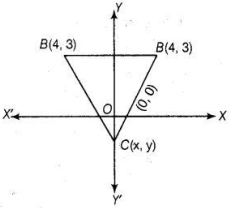
If $(-4,3)$ and $(4,3)$ are two vertices of an equilateral triangle,find the coordinates of the third vertex,given that the origin lies in the interior of the triangle.
A
$(3,3-4 \sqrt{3})$
B
$(0,3-4 \sqrt{7})$
C
$(1,3-4 \sqrt{3})$
D
$(0,3-4 \sqrt{3})$
Solution
(D) Let the vertices of the equilateral triangle be $A(-4,3)$,$B(4,3)$,and $C(x,y)$.
Since the triangle is equilateral,$AB = BC = CA$,which implies $AB^2 = BC^2 = CA^2$.
First,calculate $AB^2 = (4 - (-4))^2 + (3 - 3)^2 = 8^2 + 0^2 = 64$.
For $BC^2 = CA^2$,we have $(x-4)^2 + (y-3)^2 = (x+4)^2 + (y-3)^2$.
This simplifies to $(x-4)^2 = (x+4)^2$,which gives $x^2 - 8x + 16 = x^2 + 8x + 16$,so $16x = 0$,hence $x = 0$.
Now,use $AB^2 = BC^2$ with $x=0$: $64 = (0-4)^2 + (y-3)^2$.
$64 = 16 + (y-3)^2$,so $(y-3)^2 = 48$.
$y-3 = \pm \sqrt{48} = \pm 4\sqrt{3}$.
Thus,$y = 3 \pm 4\sqrt{3}$.
The two possible vertices are $C_1(0, 3+4\sqrt{3})$ and $C_2(0, 3-4\sqrt{3})$.
The origin $(0,0)$ lies in the interior of the triangle. For the triangle with vertices $(-4,3)$,$(4,3)$,and $(0, y)$,the $y$-coordinate of the third vertex must be less than $3$ for the origin to be inside. Since $3+4\sqrt{3} > 3$ and $3-4\sqrt{3} < 3$,the correct vertex is $(0, 3-4\sqrt{3})$.
0 likes
View Solution43
DifficultMCQ
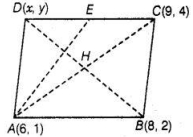
$A(6,1), B(8,2)$ and $C(9,4)$ are three vertices of a parallelogram $ABCD$. If $E$ is the midpoint of $DC$,find the area of $\triangle ADE$ (in sq. units).
A
$\frac{3}{4}$
B
$\frac{1}{4}$
C
$\frac{3}{5}$
D
$\frac{5}{3}$
Solution
(A) Given that $A(6,1), B(8,2)$ and $C(9,4)$ are three vertices of a parallelogram $ABCD$.
Let the fourth vertex $D$ be $(x, y)$.
Since the diagonals of a parallelogram bisect each other,the midpoint of $BD$ is the same as the midpoint of $AC$.
$\text{Midpoint of } AC = \left(\frac{6+9}{2}, \frac{1+4}{2}\right) = \left(\frac{15}{2}, \frac{5}{2}\right)$.
$\text{Midpoint of } BD = \left(\frac{8+x}{2}, \frac{2+y}{2}\right)$.
Equating the coordinates: $\frac{8+x}{2} = \frac{15}{2} \Rightarrow x = 7$ and $\frac{2+y}{2} = \frac{5}{2} \Rightarrow y = 3$.
So,the fourth vertex is $D(7,3)$.
$E$ is the midpoint of $DC$,so $E = \left(\frac{7+9}{2}, \frac{3+4}{2}\right) = \left(8, \frac{7}{2}\right)$.
The area of $\triangle ADE$ with vertices $A(6,1), D(7,3)$ and $E(8, 3.5)$ is given by:
$\text{Area} = \frac{1}{2} |x_1(y_2 - y_3) + x_2(y_3 - y_1) + x_3(y_1 - y_2)|$
$\text{Area} = \frac{1}{2} |6(3 - 3.5) + 7(3.5 - 1) + 8(1 - 3)|$
$\text{Area} = \frac{1}{2} |6(-0.5) + 7(2.5) + 8(-2)|$
$\text{Area} = \frac{1}{2} |-3 + 17.5 - 16|$
$\text{Area} = \frac{1}{2} |-1.5| = 0.75 = \frac{3}{4} \text{ sq. units.}$
0 likes
View Solution44
Difficult
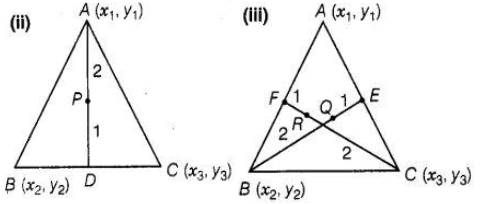
The points $A(x_{1}, y_{1})$,$B(x_{2}, y_{2})$ and $C(x_{3}, y_{3})$ are the vertices of $\triangle ABC$.
$(i)$ The median from $A$ meets $BC$ at $D$. Find the coordinates of the point $D$.
$(ii)$ Find the coordinates of the point $P$ on $AD$ such that $AP : PD = 2 : 1$.
$(iii)$ Find the coordinates of points $Q$ and $R$ on medians $BE$ and $CF$,respectively,such that $BQ : QE = 2 : 1$ and $CR : RF = 2 : 1$.
$(iv)$ What are the coordinates of the centroid of the triangle $ABC$?
Solution
(N/A) Given that the points $A(x_{1}, y_{1})$,$B(x_{2}, y_{2})$ and $C(x_{3}, y_{3})$ are the vertices of $\triangle ABC$.
$(i)$ We know that the median bisects the line segment into two equal parts,i.e.,$D$ is the mid-point of $BC$.
$\therefore$ Coordinate of mid-point of $BC = \left(\frac{x_{2}+x_{3}}{2}, \frac{y_{2}+y_{3}}{2}\right)$.
$\Rightarrow D = \left(\frac{x_{2}+x_{3}}{2}, \frac{y_{2}+y_{3}}{2}\right)$.
$(ii)$ Let the coordinates of point $P$ be $(x, y)$.
Given that the point $P(x, y)$ divides the line segment joining $A(x_{1}, y_{1})$ and $D\left(\frac{x_{2}+x_{3}}{2}, \frac{y_{2}+y_{3}}{2}\right)$ in the ratio $2 : 1$.
Using the internal section formula $\left(\frac{m_{1}x_{2}+m_{2}x_{1}}{m_{1}+m_{2}}, \frac{m_{1}y_{2}+m_{2}y_{1}}{m_{1}+m_{2}}\right)$:
$P = \left[\frac{2\left(\frac{x_{2}+x_{3}}{2}\right) + 1(x_{1})}{2+1}, \frac{2\left(\frac{y_{2}+y_{3}}{2}\right) + 1(y_{1})}{2+1}\right] = \left(\frac{x_{1}+x_{2}+x_{3}}{3}, \frac{y_{1}+y_{2}+y_{3}}{3}\right)$.
$(iii)$ Similarly,for median $BE$,$E$ is the mid-point of $AC$,so $E = \left(\frac{x_{1}+x_{3}}{2}, \frac{y_{1}+y_{3}}{2}\right)$.
Point $Q$ divides $BE$ in ratio $2 : 1$. Using the section formula:
$Q = \left[\frac{2\left(\frac{x_{1}+x_{3}}{2}\right) + 1(x_{2})}{2+1}, \frac{2\left(\frac{y_{1}+y_{3}}{2}\right) + 1(y_{2})}{2+1}\right] = \left(\frac{x_{1}+x_{2}+x_{3}}{3}, \frac{y_{1}+y_{2}+y_{3}}{3}\right)$.
For median $CF$,$F$ is the mid-point of $AB$,so $F = \left(\frac{x_{1}+x_{2}}{2}, \frac{y_{1}+y_{2}}{2}\right)$.
Point $R$ divides $CF$ in ratio $2 : 1$. Using the section formula:
$R = \left[\frac{2\left(\frac{x_{1}+x_{2}}{2}\right) + 1(x_{3})}{2+1}, \frac{2\left(\frac{y_{1}+y_{2}}{2}\right) + 1(y_{3})}{2+1}\right] = \left(\frac{x_{1}+x_{2}+x_{3}}{3}, \frac{y_{1}+y_{2}+y_{3}}{3}\right)$.
$(iv)$ The centroid of a triangle is the point where all medians intersect. Since $P, Q,$ and $R$ are all the same point,the coordinates of the centroid are $\left(\frac{x_{1}+x_{2}+x_{3}}{3}, \frac{y_{1}+y_{2}+y_{3}}{3}\right)$.
0 likes
View Solution45
Difficult
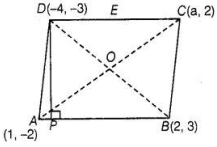
If the points $A(1, -2)$,$B(2, 3)$,$C(a, 2)$,and $D(-4, -3)$ form a parallelogram,find the value of $a$ and the height of the parallelogram taking $AB$ as the base.
Solution
(A) In a parallelogram,the diagonals bisect each other,which means the mid-point of $AC$ is equal to the mid-point of $BD$.
$\Rightarrow \left(\frac{1+a}{2}, \frac{-2+2}{2}\right) = \left(\frac{2-4}{2}, \frac{3-3}{2}\right)$
$\Rightarrow \frac{1+a}{2} = \frac{-2}{2} = -1$
$1+a = -2 \Rightarrow a = -3$
So,the value of $a$ is $-3$.
Given $AB$ as the base,let $DP$ be the height where $P$ is the foot of the perpendicular from $D$ to $AB$.
The equation of line $AB$ passing through $(1, -2)$ and $(2, 3)$ is:
$(y - (-2)) = \frac{3 - (-2)}{2 - 1}(x - 1)$
$y + 2 = 5(x - 1) \Rightarrow 5x - y = 7$ ... $(i)$
The slope of $AB$ is $m_1 = 5$. Since $DP \perp AB$,the slope of $DP$ is $m_2 = -1/5$.
The equation of line $DP$ passing through $D(-4, -3)$ with slope $-1/5$ is:
$(y + 3) = -\frac{1}{5}(x + 4)$
$5y + 15 = -x - 4 \Rightarrow x + 5y = -19$ ... $(ii)$
Solving $(i)$ and $(ii)$ for intersection point $P$:
$x + 5(5x - 7) = -19 \Rightarrow 26x = 16 \Rightarrow x = 8/13$
$y = 5(8/13) - 7 = -51/13$
$P = (8/13, -51/13)$. The height $DP$ is the distance between $D(-4, -3)$ and $P(8/13, -51/13)$:
$DP = \sqrt{(\frac{8}{13} + 4)^2 + (-\frac{51}{13} + 3)^2} = \sqrt{(\frac{60}{13})^2 + (-\frac{12}{13})^2} = \frac{1}{13}\sqrt{3600 + 144} = \frac{\sqrt{3744}}{13} = \frac{12\sqrt{26}}{13}$ units.
0 likes
View Solution46
Difficult
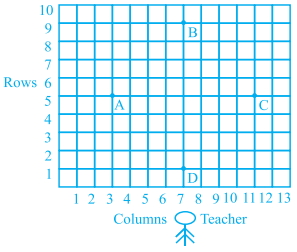
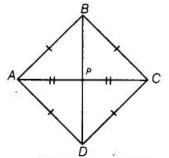
Students of a school are standing in rows and columns in their playground for a drill practice. $A, B, C$ and $D$ are the positions of four students as shown in the figure. Is it possible to place Jaspal in the drill in such a way that he is equidistant from each of the four students $A, B, C$ and $D$? If so,what should be his position?
Solution
(D) Yes,from the figure,we observe that the positions of four students $A, B, C$ and $D$ are $(3, 5), (7, 9), (11, 5)$ and $(7, 1)$ respectively. These are the four vertices of a quadrilateral.
First,we calculate the lengths of the sides using the distance formula $d = \sqrt{(x_2 - x_1)^2 + (y_2 - y_1)^2}$:
$AB = \sqrt{(7 - 3)^2 + (9 - 5)^2} = \sqrt{4^2 + 4^2} = \sqrt{16 + 16} = \sqrt{32} = 4\sqrt{2}$
$BC = \sqrt{(11 - 7)^2 + (5 - 9)^2} = \sqrt{4^2 + (-4)^2} = \sqrt{16 + 16} = \sqrt{32} = 4\sqrt{2}$
$CD = \sqrt{(7 - 11)^2 + (1 - 5)^2} = \sqrt{(-4)^2 + (-4)^2} = \sqrt{16 + 16} = \sqrt{32} = 4\sqrt{2}$
$DA = \sqrt{(3 - 7)^2 + (5 - 1)^2} = \sqrt{(-4)^2 + 4^2} = \sqrt{16 + 16} = \sqrt{32} = 4\sqrt{2}$
Since all sides are equal,it is a rhombus.
Next,we calculate the lengths of the diagonals:
$AC = \sqrt{(11 - 3)^2 + (5 - 5)^2} = \sqrt{8^2 + 0^2} = 8$
$BD = \sqrt{(7 - 7)^2 + (1 - 9)^2} = \sqrt{0^2 + (-8)^2} = 8$
Since the diagonals are also equal $(AC = BD)$,the quadrilateral $ABCD$ is a square.
In a square,the point equidistant from all four vertices is the intersection point of the diagonals,which is the midpoint of either diagonal.
Using the midpoint formula for $AC$:
$P = \left(\frac{3 + 11}{2}, \frac{5 + 5}{2}\right) = \left(\frac{14}{2}, \frac{10}{2}\right) = (7, 5)$
Thus,Jaspal should be placed at position $(7, 5)$.
0 likes
View Solution47
Difficult
Show that $(-2,-3), (6,3), (3,7),$ and $(-5,1)$ are the vertices of a rectangle.
Solution
(A) Let the vertices be $A(-2,-3), B(6,3), C(3,7),$ and $D(-5,1).$
First,we calculate the lengths of the sides using the distance formula $d = \sqrt{(x_2-x_1)^2 + (y_2-y_1)^2}$:
$AB^2 = (-2-6)^2 + (-3-3)^2 = (-8)^2 + (-6)^2 = 64 + 36 = 100 \implies AB = 10$
$BC^2 = (6-3)^2 + (3-7)^2 = (3)^2 + (-4)^2 = 9 + 16 = 25 \implies BC = 5$
$CD^2 = (3 - (-5))^2 + (7-1)^2 = (8)^2 + (6)^2 = 64 + 36 = 100 \implies CD = 10$
$DA^2 = (-5 - (-2))^2 + (1 - (-3))^2 = (-3)^2 + (4)^2 = 9 + 16 = 25 \implies DA = 5$
Since opposite sides are equal ($AB=CD=10$ and $BC=DA=5$),the quadrilateral is a parallelogram.
Next,we check the diagonal $AC$:
$AC^2 = (-2-3)^2 + (-3-7)^2 = (-5)^2 + (-10)^2 = 25 + 100 = 125$
In $\triangle ABC$,$AB^2 + BC^2 = 100 + 25 = 125 = AC^2$.
By the converse of the Pythagorean theorem,$\angle B = 90^\circ$.
Since the parallelogram has one right angle,it is a rectangle.
0 likes
View Solution48
DifficultMCQ
If $(-8, -4), (-2, 4)$ and $(5, a)$ are collinear points,then find the value of $a$.
A
$\frac{50}{3}$
B
$\frac{11}{3}$
C
$\frac{44}{3}$
D
$\frac{40}{3}$
Solution
(D) Three points $(x_1, y_1), (x_2, y_2)$ and $(x_3, y_3)$ are collinear if the slope of the line segment joining the first two points is equal to the slope of the line segment joining the last two points.
Slope $m_1$ of the line segment joining $(-8, -4)$ and $(-2, 4)$ is given by $m_1 = \frac{y_2 - y_1}{x_2 - x_1} = \frac{4 - (-4)}{-2 - (-8)} = \frac{8}{6} = \frac{4}{3}$.
Slope $m_2$ of the line segment joining $(-2, 4)$ and $(5, a)$ is given by $m_2 = \frac{a - 4}{5 - (-2)} = \frac{a - 4}{7}$.
Since the points are collinear,$m_1 = m_2$.
Therefore,$\frac{4}{3} = \frac{a - 4}{7}$.
Multiplying both sides by $21$,we get $4 \times 7 = 3(a - 4)$.
$28 = 3a - 12$.
$3a = 28 + 12 = 40$.
$a = \frac{40}{3}$.
0 likes
View Solution49
MediumMCQ
In $\Delta ABC$,if $A(1, 7)$,$B(2, 4)$,and $C(k, 5)$ and $\angle A$ is a right angle,then find the value of $k$.
A
$-6$
B
$-8$
C
$-3$
D
$-5$
Solution
(D) Given that $\angle A = 90^{\circ}$,the sides $AB$ and $AC$ are perpendicular to each other.
Therefore,the product of their slopes must be $-1$,i.e.,$m_{AB} \times m_{AC} = -1$.
The slope of a line passing through $(x_1, y_1)$ and $(x_2, y_2)$ is given by $m = \frac{y_2 - y_1}{x_2 - x_1}$.
Slope of $AB$ $(m_{AB})$ = $\frac{4 - 7}{2 - 1} = \frac{-3}{1} = -3$.
Slope of $AC$ $(m_{AC})$ = $\frac{5 - 7}{k - 1} = \frac{-2}{k - 1}$.
Since $m_{AB} \times m_{AC} = -1$,we have $(-3) \times \left( \frac{-2}{k - 1} \right) = -1$.
$\frac{6}{k - 1} = -1$.
$6 = -(k - 1)$.
$6 = -k + 1$.
$k = 1 - 6 = -5$.
0 likes
View Solution50
Difficult
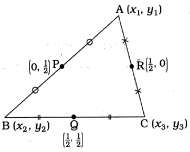
$P(0, 1/2)$,$Q(1/2, 1/2)$,and $R(1/2, 0)$ are respectively the midpoints of sides $\overline{AB}$,$\overline{BC}$,and $\overline{CA}$ in $\Delta ABC$. Find the coordinates of $A$,$B$,and $C$.
Solution
(A) Let $A(x_1, y_1)$,$B(x_2, y_2)$,and $C(x_3, y_3)$ be the vertices of $\Delta ABC$. Given that $P(0, 1/2)$,$Q(1/2, 1/2)$,and $R(1/2, 0)$ are the midpoints of sides $\overline{AB}$,$\overline{BC}$,and $\overline{CA}$ respectively.
For $x$-coordinates:
$(x_1 + x_2)/2 = 0 \implies x_1 + x_2 = 0$ $(i)$
$(x_2 + x_3)/2 = 1/2 \implies x_2 + x_3 = 1$ (ii)
$(x_3 + x_1)/2 = 1/2 \implies x_3 + x_1 = 1$ (iii)
Adding $(i)$,(ii),and (iii): $2(x_1 + x_2 + x_3) = 2 \implies x_1 + x_2 + x_3 = 1$.
Subtracting (ii) from the sum: $x_1 = 1 - 1 = 0$.
Subtracting (iii) from the sum: $x_2 = 1 - 1 = 0$.
Subtracting $(i)$ from the sum: $x_3 = 1 - 0 = 1$.
For $y$-coordinates:
$(y_1 + y_2)/2 = 1/2 \implies y_1 + y_2 = 1$ (iv)
$(y_2 + y_3)/2 = 1/2 \implies y_2 + y_3 = 1$ $(v)$
$(y_3 + y_1)/2 = 0 \implies y_3 + y_1 = 0$ (vi)
Adding (iv),$(v)$,and (vi): $2(y_1 + y_2 + y_3) = 2 \implies y_1 + y_2 + y_3 = 1$.
Subtracting $(v)$ from the sum: $y_1 = 1 - 1 = 0$.
Subtracting (vi) from the sum: $y_2 = 1 - 0 = 1$.
Subtracting (iv) from the sum: $y_3 = 1 - 1 = 0$.
Thus,the vertices are $A(0, 0)$,$B(0, 1)$,and $C(1, 0)$.
0 likes
View SolutionCoordinate Geometry — Mix Examples - Coordinate Geometry · Frequently Asked Questions
1Are these Coordinate Geometry questions useful for JEE and NEET?
Yes. All questions in this section are mapped to JEE Main and NEET exam patterns. Previous year questions from JEE Main, NEET, GUJCET and state-level exams are included with full solutions.
2Can I switch to Hindi or Gujarati for these questions?
Yes. Use the language tabs in the hero section or the sidebar to view the same questions and solutions in English, Hindi or Gujarati.
3How do I generate a question paper from this subtopic?
Use the Vedclass Exam Paper Generator — select the chapter and subtopic, set difficulty, and generate Sets A, B, C, D automatically. First 3 chapters of every subject are free.
Vedclass Products
For Students
Vedclass Test Series
Mock tests in real JEE/NEET style with performance analysis. 5-day free trial.
Start Free TrialFor Teachers
Exam Paper Generator
Generate Set A/B/C/D papers from this chapter in 2 minutes. 3 chapters free.
Try FreeFor Institutes
Online Exam Module
Live online exams with unlimited students, 360° analytics & white-label branding.
See DemoFor Teachers & Institutes
Generate a Coordinate Geometry Exam Paper in 2 Minutes
Select subtopic & difficulty — Sets A, B, C, D auto-generated with No Repeat logic.
First 3 chapters of every subject are free — no payment required.