
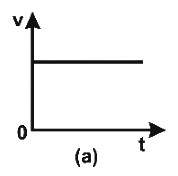
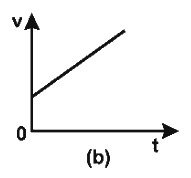
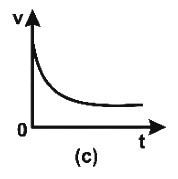
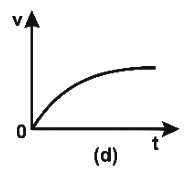
$A$ small metal sphere is falling through a viscous liquid. The variation of velocity $(V)$ with time $(t)$ is shown correctly in which graph?
- A
- B
- C
- D
Explore More
Similar Questions
The terminal velocity of a liquid drop of radius $r$ falling through air is $v$. If two such drops are combined to form a bigger drop,the terminal velocity with which the bigger drop falls through air is (ignore any buoyant force due to air).
DifficultAP EAMCET 2013
View SolutionTwo solid spheres of radii $2 \ mm$ and $4 \ mm$ are tied to the two ends of a light string and released in a liquid of specific gravity $1.3$ and coefficient of viscosity $1 \ Pa \cdot s$. The string is just taut when the two spheres are completely submerged in the liquid. If the density of the materials of the two spheres is $2800 \ kg \cdot m^{-3}$,then the terminal velocity of the system of the spheres is (take $g = 10 \ m \cdot s^{-2}$):
DifficultAP EAMCET 2018
View Solution$A$ rain drop of radius $r$ is falling through air,starting from rest. The work done by all the forces on the drop,when it attains terminal velocity,is proportional to
$A$ small spherical solid ball is dropped in a viscous liquid. Its journey in the liquid is best described by which curve in the figure?
Medium
View SolutionTwo spheres of different material are falling through a liquid of density $\rho_L = 2 \times 10^3 \ kg/m^3$ with the same uniform terminal speed. The density of sphere $1$ is $\rho_1 = 8 \times 10^3 \ kg/m^3$ and the density of sphere $2$ is $\rho_2 = 11 \times 10^3 \ kg/m^3$. The ratio of their radii $(r_1/r_2)$ is:
Vedclass Products
For Students
Vedclass Test Series
Mock tests in real JEE/NEET style with performance analysis. 5-day free trial.
Start Free TrialFor Teachers
Exam Paper Generator
Generate Set A/B/C/D exam papers from 7.5L+ questions in 2 minutes. 3 chapters free.
Try FreeFor Institutes
Online Exam Module
Live online exams with unlimited students, 360° analytics & white-label branding.
See Demo