
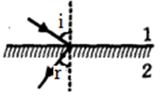
In a laboratory,a material is created with a negative refractive index. $A$ light ray enters from medium $1$ into this material (medium $2$). Which of the following diagrams correctly represents the path of the ray?
- A
- B
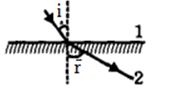
- C
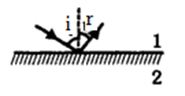
- D
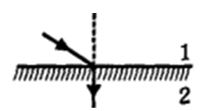
Explore More
Similar Questions
$A$ concave mirror is placed on a horizontal table,with its axis directed vertically upwards. Let $O$ be the pole of the mirror and $C$ its centre of curvature. $A$ point object is placed at $C$. It has a real image,also located at $C$ (a condition called auto-collimation). If the mirror is now filled with water,the image will be:
Difficult
View SolutionAn optical component and an object $S$ placed along its optic axis are given in Column $I$. The distance between the object and the component can be varied. The properties of images are given in Column $II$. Match all the properties of images from Column $II$ with the appropriate components given in Column $I$.
Column $I$ Column $II$ $A$. Concave Mirror $(p)$ Real image $B$. Convex Mirror $(q)$ Virtual image $C$. Convex Lens $(r)$ Magnified image $D$. Concave Lens $(s)$ Image at infinity
| Column $I$ | Column $II$ |
| $A$. Concave Mirror | $(p)$ Real image |
| $B$. Convex Mirror | $(q)$ Virtual image |
| $C$. Convex Lens | $(r)$ Magnified image |
| $D$. Concave Lens | $(s)$ Image at infinity |
An object is placed in front of a convex mirror at a distance of $50\, cm$. $A$ plane mirror is introduced covering the lower half of the convex mirror. If the distance between the object and the plane mirror is $30\, cm$,it is found that there is no parallax between the images formed by the two mirrors. The magnification of the convex mirror will be......
Difficult
View Solution$A$ beaker of radius $r$ is filled with water (refractive index $\frac{4}{3}$) up to a height $H$ as shown in the figure. The beaker is kept on a horizontal table rotating with angular speed $\omega$. This makes the water surface curved so that the difference in the height of the water level at the center and at the circumference of the beaker is $h$ $(h \ll H, h \ll r)$,as shown in the figure. Take this surface to be approximately spherical with a radius of curvature $R$. Which of the following is/are correct? ($g$ is the acceleration due to gravity)
$(A)$ $R=\frac{h^2+r^2}{2 h}$
$(B)$ $R=\frac{r^2}{2 h}$
$(C)$ Apparent depth of the bottom of the beaker is close to $\frac{3 H}{4}\left(1+\frac{\omega^2 H}{4 g}\right)^{-1}$
$(D)$ Apparent depth of the bottom of the beaker is close to $\frac{3 H}{2}\left(1+\frac{\omega^2 H}{2 g}\right)^{-1}$
$(A)$ $R=\frac{h^2+r^2}{2 h}$
$(B)$ $R=\frac{r^2}{2 h}$
$(C)$ Apparent depth of the bottom of the beaker is close to $\frac{3 H}{4}\left(1+\frac{\omega^2 H}{4 g}\right)^{-1}$
$(D)$ Apparent depth of the bottom of the beaker is close to $\frac{3 H}{2}\left(1+\frac{\omega^2 H}{2 g}\right)^{-1}$
$A$ ray of sunlight enters a spherical water droplet $(n = 4/3)$ at an angle of incidence $53^o$ measured with respect to the normal to the surface. It is reflected from the back surface of the droplet and re-enters into air. The angle between the incoming and outgoing ray is $.......^o$ [Take $\sin \,53^o = 0.8$]
Vedclass Products
For Students
Vedclass Test Series
Mock tests in real JEE/NEET style with performance analysis. 5-day free trial.
Start Free TrialFor Teachers
Exam Paper Generator
Generate Set A/B/C/D exam papers from 7.5L+ questions in 2 minutes. 3 chapters free.
Try FreeFor Institutes
Online Exam Module
Live online exams with unlimited students, 360° analytics & white-label branding.
See Demo