
$A$ ball is dropped vertically downwards from a height $h$ above the ground. It hits the ground inelastically and bounces up vertically. Neglecting subsequent motion and air resistance,which of the following graphs represents the variation between speed $(v)$ and height $(h)$ correctly?
- A
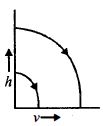
- B
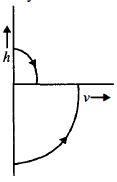
- C
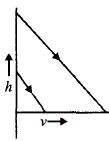
- D
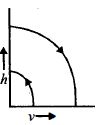
Explore More
Similar Questions
$A$ block of mass $m$ starts from rest and slides down a frictionless semi-circular track from a height $h$ as shown. When it reaches the lowest point of the track,it collides with a stationary piece of putty also having mass $m$. If the block and the putty stick together and continue to slide,the maximum height that the block-putty system could reach is:
An object of mass $M$ is at rest on a smooth horizontal surface. Objects of different masses collide head-on elastically with the object of mass $M$. All colliding objects have the same fixed kinetic energy $E$,and in each case,mass $M$ is initially at rest. The kinetic energy transferred to the stationary mass $M$ depends on the linear momentum $P$ of the incoming colliding mass. How does the energy transferred to $M$ vary with the linear momentum $P$?
Difficult
View Solution$A$ body of mass $m$ is dropped from a height of $h$. Simultaneously,another body of mass $2m$ is thrown vertically upward with such a velocity $v$ that they collide at a height $h/2$. If the collision is perfectly inelastic,the velocity at the time of collision with the ground will be:
Difficult
View Solution$A$ block of mass '$m$' moving on a frictionless horizontal surface collides with a spring of spring constant '$K$' and compresses it through a distance '$x$'. The maximum momentum of the block after collision is
DifficultMHT CET 2026
View Solution$A$ spring-block system is resting on a frictionless floor as shown in the figure. The spring constant is $2.0 \ N \ m^{-1}$ and the mass of the block is $2.0 \ kg$. Ignore the mass of the spring. Initially,the spring is in an unstretched condition. Another block of mass $1.0 \ kg$ moving with a speed of $2.0 \ m \ s^{-1}$ collides elastically with the first block. The collision is such that the $2.0 \ kg$ block does not hit the wall. The distance,in metres,between the two blocks when the spring returns to its unstretched position for the first time after the collision is . . . . .
Vedclass Products
For Students
Vedclass Test Series
Mock tests in real JEE/NEET style with performance analysis. 5-day free trial.
Start Free TrialFor Teachers
Exam Paper Generator
Generate Set A/B/C/D exam papers from 7.5L+ questions in 2 minutes. 3 chapters free.
Try FreeFor Institutes
Online Exam Module
Live online exams with unlimited students, 360° analytics & white-label branding.
See Demo