
Medium
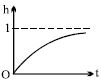
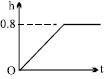
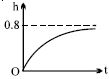
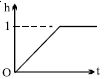
$A$ cylindrical tank of height $1 \ m$ and cross-sectional area $A = 4000 \ cm^2$ is initially empty. It is kept under a tap of cross-sectional area $a_1 = 1 \ cm^2$. Water starts flowing from the tap at $t = 0$ with a speed $v_1 = 2 \ m/s$. There is a small hole in the base of the tank of cross-sectional area $a_2 = 0.5 \ cm^2$. The variation of the height of water in the tank (in meters) with time $t$ is best depicted by:
- A
- B
- C
- D
Explore More
Similar Questions
Fill in the blanks:
$(i)$ The lines of flow and streamlines coincide with each other in ...... flow.
$(ii)$ The formula for the horizontal velocity of water coming from a hole at the bottom at a height $h$ from the surface of the water is ......
$(iii)$ $1 \ Pa = ...... \ dyne/cm^{2}$
$(iv)$ The relative velocity of two parallel layers of water is $6 \ cm/s$. If the perpendicular distance between the two layers is $0.1 \ mm$,then the velocity gradient will be ......
Medium
View Solution$A$ table tennis ball has radius $(3 / 2) \times 10^{-2} \text{ m}$ and mass $(22 / 7) \times 10^{-3} \text{ kg}$. It is slowly pushed down into a swimming pool to a depth of $d = 0.7 \text{ m}$ below the water surface and then released from rest. It emerges from the water surface at speed $v$,without getting wet,and rises up to a height $H$. Which of the following option$(s)$ is (are) correct?
[Given: $\pi = 22 / 7, g = 10 \text{ ms}^{-2}$,density of water $= 1 \times 10^3 \text{ kg m}^{-3}$,viscosity of water $= 1 \times 10^{-3} \text{ Pa-s}$.]
$(A)$ The work done in pushing the ball to the depth $d$ is $0.077 \text{ J}$.
$(B)$ If we neglect the viscous force in water,then the speed $v = 7 \text{ m/s}$.
$(C)$ If we neglect the viscous force in water,then the height $H = 1.4 \text{ m}$.
$(D)$ The ratio of the magnitudes of the net force excluding the viscous force to the maximum viscous force in water is $500 / 9$.
Two blocks of ice when pressed together join to form one block because
$A$ drum of radius $R$ full of liquid of density $d$ is rotated at angular velocity $\omega \ rad/s$. The increase in pressure at the centre of the drum will be
DifficultMHT CET 2024
View Solution$A$ balloon is made of a material of surface tension $S$ and its inflation outlet (from where gas is filled in it) has small area $A$. It is filled with a gas of density $\rho$ and takes a spherical shape of radius $R$. When the gas is allowed to flow freely out of it,its radius changes from $R$ to $0$ in time $T$. If the speed $\psi(r)$ of gas coming out of the balloon depends on $r$ as $r^\alpha$ and $T \propto S^a A^\beta \rho^\gamma R^\delta$,then:
DifficultNEET 2025
View SolutionVedclass Products
For Students
Vedclass Test Series
Mock tests in real JEE/NEET style with performance analysis. 5-day free trial.
Start Free TrialFor Teachers
Exam Paper Generator
Generate Set A/B/C/D exam papers from 7.5L+ questions in 2 minutes. 3 chapters free.
Try FreeFor Institutes
Online Exam Module
Live online exams with unlimited students, 360° analytics & white-label branding.
See Demo