
Class 11PhysicsSystem of Particles and Rotational MotionMix Example - System of Particles and Rotational Motion
Medium$A$ ladder is leaned against a smooth wall and it is allowed to slip on a frictionless floor. Which figure represents the track of its centre of mass?
- A
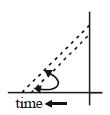
- B
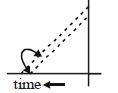
- C
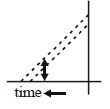
- D
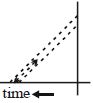
Explore More
Similar Questions
$A$ uniform thin cylindrical disk of mass $M$ and radius $R$ is attached to two identical massless springs of spring constant $k$ which are fixed to the wall as shown in the figure. The springs are attached to the axle of the disk symmetrically on either side at a distance $d$ from its centre. The axle is massless and both the springs and the axle are in a horizontal plane. The unstretched length of each spring is $L$. The disk is initially at its equilibrium position with its centre of mass $(CM)$ at a distance $L$ from the wall. The disk rolls without slipping with velocity $\vec{V}_0 = V_0 \hat{i}$. The coefficient of friction is $\mu$.
$1.$ The net external force acting on the disk when its centre of mass is at displacement $x$ with respect to its equilibrium position is
$(A) -kx$ $(B) -2kx$ $(C) -\frac{2kx}{3}$ $(D) -\frac{4kx}{3}$
$2.$ The centre of mass of the disk undergoes simple harmonic motion with angular frequency $\omega$ equal to
$(A) \sqrt{\frac{k}{M}}$ $(B) \sqrt{\frac{2k}{M}}$ $(C) \sqrt{\frac{2k}{3M}}$ $(D) \sqrt{\frac{4k}{3M}}$
$3.$ The maximum value of $V_0$ for which the disk will roll without slipping is
$(A) \mu g \sqrt{\frac{M}{k}}$ $(B) \mu g \sqrt{\frac{M}{2k}}$ $(C) \mu g \sqrt{\frac{3M}{k}}$ $(D) \mu g \sqrt{\frac{5M}{2k}}$
$A$ body weighs $6$ g when placed in one pan and $24$ g when placed on the other pan of a false balance. If the beam is horizontal when both the pans are empty,the true weight of the body is ....... g.
Difficult
View Solution$A$ ring of mass $M$ and radius $R$ sliding with a velocity $v_0$ suddenly enters a rough surface where the coefficient of friction is $\mu$,as shown in the figure. Choose the correct alternative$(s)$.
Three solid spheres each of mass $m$ and diameter $d$ are stuck together such that the lines connecting the centres form an equilateral triangle of side length $d$. The ratio $I_{0} / I_{A}$ of the moment of inertia $I_{0}$ of the system about an axis passing through the centroid and perpendicular to the plane of the triangle,to the moment of inertia $I_{A}$ about an axis passing through the center of any one of the spheres and perpendicular to the plane of the triangle,is:
DifficultJEE MAIN 2020
View SolutionOne of two identical cylinders,cylinder $A$,rotates at an angular speed of $50 \text{ revolutions per second}$. This rotating cylinder is brought into contact with a second stationary cylinder,$B$. Due to kinetic friction between the two cylinders,the stationary cylinder starts rotating with an angular acceleration,while cylinder $A$ undergoes angular deceleration. If the magnitude of the angular acceleration for both cylinders is $1 \text{ revolution per second}^2$,after how many seconds $(t)$ will the angular speeds of both cylinders become equal?
Difficult
View SolutionVedclass Products
For Students
Vedclass Test Series
Mock tests in real JEE/NEET style with performance analysis. 5-day free trial.
Start Free TrialFor Teachers
Exam Paper Generator
Generate Set A/B/C/D exam papers from 7.5L+ questions in 2 minutes. 3 chapters free.
Try FreeFor Institutes
Online Exam Module
Live online exams with unlimited students, 360° analytics & white-label branding.
See Demo