
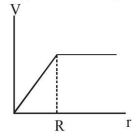
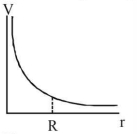
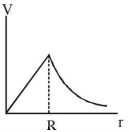
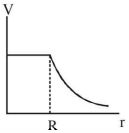
$A$ spherically symmetric gravitational system of particles has a mass density $\rho = \begin{cases} \rho_0 & \text{for } r \leq R \\ 0 & \text{for } r > R \end{cases}$ where $\rho_0$ is a constant. $A$ test mass can undergo circular motion under the influence of the gravitational field of particles. Its speed $V$ as a function of distance $r$ $(0 < r < \infty)$ from the centre of the system is represented by:
- A
- B
- C
- D
Explore More
Similar Questions
$A$ sequence of how many nucleotides in messenger $RNA$ makes a codon for an amino acid?
In the following indicator diagram,the net amount of work done will be
Intercalary meristem results in
Assertion $(A)$: Rapidly changing temperatures can be measured by thermocouples. Reason $(R)$: The thermal capacity of the junction of a thermocouple is very small.
Which vegetable crop,released by $IARI$ New Delhi,is enriched with Vitamin $C$?
Vedclass Products
For Students
Vedclass Test Series
Mock tests in real JEE/NEET style with performance analysis. 5-day free trial.
Start Free TrialFor Teachers
Exam Paper Generator
Generate Set A/B/C/D exam papers from 7.5L+ questions in 2 minutes. 3 chapters free.
Try FreeFor Institutes
Online Exam Module
Live online exams with unlimited students, 360° analytics & white-label branding.
See Demo