
Charges are uniformly spread on the surface of a conducting sphere. The electric field from the centre of the sphere to a point outside the sphere varies with distance $r$ from the centre as:
- A
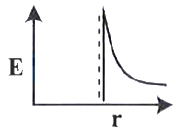
- B
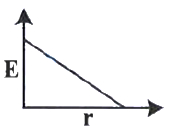
- C
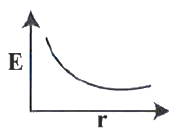
- D
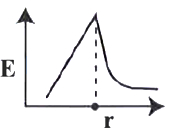
Explore More
Similar Questions
Two large,thin metal plates are parallel and close to each other. Their inner faces have surface charge densities of the same sign and magnitude $17.7 \times 10^{-22} \ C/m^2$. What is the electric field $E$ in the outer region of the second plate?
Obtain the expression for the electric field due to:
$(i)$ An infinite plane sheet with uniform charge distribution.
$(ii)$ $A$ thin spherical shell with uniform charge distribution at a point outside it.
$(iii)$ $A$ thin spherical shell with uniform charge distribution at a point inside it.
$(i)$ An infinite plane sheet with uniform charge distribution.
$(ii)$ $A$ thin spherical shell with uniform charge distribution at a point outside it.
$(iii)$ $A$ thin spherical shell with uniform charge distribution at a point inside it.
Difficult
View SolutionAn isolated sphere of radius $R$ contains a uniform volume distribution of positive charge. Which of the curves shown below correctly illustrates the dependence of the magnitude of the electric field of the sphere as a function of the distance $r$ from its centre?
The electric field due to an infinitely long thin straight wire with uniform linear charge density of $2.5 \times 10^{-7} \ Cm^{-1}$ at a radial distance of $x$ from the wire is $7.5 \times 10^4 \ NC^{-1}$. Then $x=$ (in $cm$)
For two infinitely long charged parallel sheets with the same surface charge density $\sigma$,the electric field at point $P$ between them is:
Easy
View SolutionVedclass Products
For Students
Vedclass Test Series
Mock tests in real JEE/NEET style with performance analysis. 5-day free trial.
Start Free TrialFor Teachers
Exam Paper Generator
Generate Set A/B/C/D exam papers from 7.5L+ questions in 2 minutes. 3 chapters free.
Try FreeFor Institutes
Online Exam Module
Live online exams with unlimited students, 360° analytics & white-label branding.
See Demo