
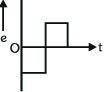
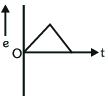
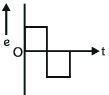
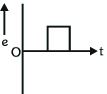
The current through a coil varies according to the following graph. Plot the graph for induced $emf$ $(e)$ versus time $(t)$ for the coil.
- A
- B
- C
- D
Explore More
Similar Questions
The diagram below shows two coils $A$ and $B$ placed parallel to each other at a very small distance. Coil $A$ is connected to an ac supply. $G$ is a very sensitive galvanometer. When the key $K$ is closed:
Easy
View Solution$A$ flexible wire bent in the form of a circle is placed in a uniform magnetic field perpendicular to the plane of the coil. The radius of the coil changes as shown in the figure. The graph of induced $emf$ in the coil is represented by
Difficult
View Solution$STATEMENT-1$ $A$ vertical iron rod has a coil of wire wound over it at the bottom end. An alternating current flows in the coil. The rod goes through a conducting ring as shown in the figure. The ring can float at a certain height above the coil. Because
$STATEMENT-2$ In the above situation,a current is induced in the ring which interacts with the radial component of the magnetic field to produce an average force in the upward direction.
$STATEMENT-2$ In the above situation,a current is induced in the ring which interacts with the radial component of the magnetic field to produce an average force in the upward direction.
DifficultIIT 2007
View SolutionIn the circuit shown below,all the inductors (assumed ideal) and resistors are identical. The current through the resistance on the right is $I$ after the key $K$ has been switched $ON$ for a long time. The currents through the three resistors (in order,from left to right) immediately after the key is switched $OFF$ are
DifficultKVPY 2015
View Solution$A$ source of constant voltage $V$ is connected to a resistance $R$ and two ideal inductors $L_1$ and $L_2$ through a switch $S$ as shown. There is no mutual inductance between the two inductors. The switch $S$ is initially open. At $t=0$,the switch is closed and current begins to flow. Which of the following options is/are correct?
$[A]$ After a long time,the current through $L_1$ will be $\frac{V}{R} \frac{L_2}{L_1+L_2}$
$[B]$ After a long time,the current through $L_2$ will be $\frac{V}{R} \frac{L_1}{L_1+L_2}$
$[C]$ The ratio of the currents through $L_1$ and $L_2$ is fixed at all times $(t>0)$
$[D]$ At $t=0$,the current through the resistance $R$ is $\frac{V}{R}$
Vedclass Products
For Students
Vedclass Test Series
Mock tests in real JEE/NEET style with performance analysis. 5-day free trial.
Start Free TrialFor Teachers
Exam Paper Generator
Generate Set A/B/C/D exam papers from 7.5L+ questions in 2 minutes. 3 chapters free.
Try FreeFor Institutes
Online Exam Module
Live online exams with unlimited students, 360° analytics & white-label branding.
See Demo