
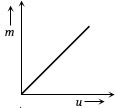
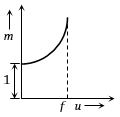
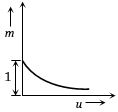
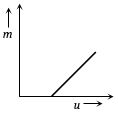
For a concave mirror, if a virtual image is formed, the graph between $m$ and $u$ is of the form:
- A
- B
- C
- D
Explore More
Similar Questions
Column-$I$ contains a list of mirrors and positions of an object. Match this with Column-$II$ describing the nature of the image formed.
Medium
View SolutionAn optical arrangement consists of two concave mirrors $M_1$ and $M_2$,and a convex lens $L$ with a common principal axis,as shown in the figure. The focal length of $L$ is $10 \text{ cm}$. The radii of curvature of $M_1$ and $M_2$ are $20 \text{ cm}$ and $24 \text{ cm}$,respectively. The distance between $L$ and $M_2$ is $20 \text{ cm}$. $A$ point object $S$ is placed at the mid-point between $L$ and $M_2$ on the axis. When the distance between $L$ and $M_1$ is $n/7 \text{ cm}$,one of the images coincides with $S$. The value of $n$ is. . . .
Five lumen/watt is the luminous efficiency of a lamp and its luminous intensity is $35$ candela. The power of the lamp is.......$W$
Medium
View SolutionThree plane mirrors form an equilateral triangle with each side of length $L$. There is a small hole at a distance $l > 0$ from one of the corners as shown in the figure. $A$ ray of light is passed through the hole at an angle $\theta$ and can only come out through the same hole. The cross section of the mirror configuration and the ray of light lie on the same plane.
Which of the following statement(s) is(are) correct?
$(A)$ The ray of light will come out for $\theta=30^{\circ}$, for $0 < l < L$.
$(B)$ There is an angle for $l=\frac{L}{2}$ at which the ray of light will come out after two reflections.
$(C)$ The ray of light will $NEVER$ come out for $\theta=60^{\circ}$, and $l=\frac{L}{3}$.
$(D)$ The ray of light will come out for $\theta=60^{\circ}$, and $0 < l < \frac{L}{2}$ after six reflections.
$A$ $60 \text{ W}$ bulb is hung over the center of a table of size $4 \text{ m} \times 4 \text{ m}$ at a height of $3 \text{ m}$. The ratio of the intensities of illumination at a point on the center of the edge $(A)$ and at the corner of the table $(B)$ is:
Difficult
View SolutionVedclass Products
For Students
Vedclass Test Series
Mock tests in real JEE/NEET style with performance analysis. 5-day free trial.
Start Free TrialFor Teachers
Exam Paper Generator
Generate Set A/B/C/D exam papers from 7.5L+ questions in 2 minutes. 3 chapters free.
Try FreeFor Institutes
Online Exam Module
Live online exams with unlimited students, 360° analytics & white-label branding.
See Demo