
Class 12PhysicsElectrostatic Potential and CapacitanceMix Examples - Electric Potential and Capacitance
MediumFor a hollow spherical shell of radius $R$ carrying a charge $q$,how does the electric potential $(V)$ change with respect to the distance $(s)$ from the centre?
- A
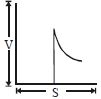
- B

- C

- D

Explore More
Similar Questions
$A$ circuit is shown in the figure for which $C_1=(3 \pm 0.011) \mu F$,$C_2=(5 \pm 0.01) \mu F$,and $C_3=(1 \pm 0.01) \mu F$. If $C$ is the equivalent capacitance across $AB$,then $C$ is given by:
In the circuit shown below, $C_1 = 10 \, \mu F$, $C_2 = C_3 = 20 \, \mu F$, and $C_4 = 40 \, \mu F$. If the charge on $C_1$ is $20 \, \mu C$, then the potential difference between $X$ and $Y$ is ......... $V$.
Medium
View SolutionIn the figure,the area of each plate is $A$ and the distance between consecutive plates is $d$. What is the effective capacitance between points $A$ and $B$?
Given below are two statements: one is labelled as Assertion $A$ and the other is labelled as Reason $R$.
Assertion $A$: In electrostatics, a conductor does not store any net charge inside.
Reason $R$: Inside the capacitor (with no dielectric medium), the free charge carriers, if placed between the plates of capacitor, experience force and drift.
Choose the correct answer from the options given below:
Assertion $A$: In electrostatics, a conductor does not store any net charge inside.
Reason $R$: Inside the capacitor (with no dielectric medium), the free charge carriers, if placed between the plates of capacitor, experience force and drift.
Choose the correct answer from the options given below:
Three capacitors $C_1, C_2$ and $C_3$ are connected as shown in the figure to a battery of $V$ volt. If the capacitor $C_3$ breaks down electrically,the change in total charge on the combination of capacitors is
DifficultAIIMS 2010
View SolutionVedclass Products
For Students
Vedclass Test Series
Mock tests in real JEE/NEET style with performance analysis. 5-day free trial.
Start Free TrialFor Teachers
Exam Paper Generator
Generate Set A/B/C/D exam papers from 7.5L+ questions in 2 minutes. 3 chapters free.
Try FreeFor Institutes
Online Exam Module
Live online exams with unlimited students, 360° analytics & white-label branding.
See Demo