
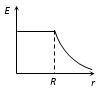
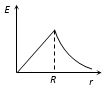
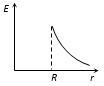
In a uniformly charged sphere of total charge $Q$ and radius $R$,the electric field $E$ is plotted as a function of distance $r$ from the center. The graph which would correspond to the above is:
- A
- B
- C
- D
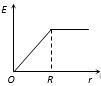
Explore More
Similar Questions
In finding the electric field using Gauss's Law,the formula $|\overrightarrow{E}| = \frac{q_{enc}}{\varepsilon_{0}|A|}$ is applicable. In the formula,$\varepsilon_{0}$ is the permittivity of free space,$A$ is the area of the Gaussian surface,and $q_{enc}$ is the charge enclosed by the Gaussian surface. The equation can be used in which of the following situations?
Two long thin charged rods with charge density $\lambda$ each are placed parallel to each other at a distance $d$ apart. The force per unit length exerted on one rod by the other will be (where $k = \frac{1}{4 \pi \varepsilon_0}$)
Medium
View Solution$A$ spherical shell with an inner radius $a$ and an outer radius $b$ is made of conducting material. $A$ point charge $+Q$ is placed at the centre of the spherical shell and a total charge $-q$ is placed on the shell. Charge $-q$ is distributed on the surfaces as:
Difficult
View SolutionIf an insulated non-conducting sphere of radius $R$ has charge density $\rho$,the electric field at a distance $r$ from the centre of the sphere $(r < R)$ will be
Medium
View SolutionThe surface charge density of a thin charged disc of radius $R$ is $\sigma$. The value of the electric field at the centre of the disc is $\frac{\sigma}{2\epsilon_0}$. With respect to the field at the centre,the electric field along the axis at a distance $R$ from the centre of the disc:
DifficultJEE MAIN 2013
View SolutionVedclass Products
For Students
Vedclass Test Series
Mock tests in real JEE/NEET style with performance analysis. 5-day free trial.
Start Free TrialFor Teachers
Exam Paper Generator
Generate Set A/B/C/D exam papers from 7.5L+ questions in 2 minutes. 3 chapters free.
Try FreeFor Institutes
Online Exam Module
Live online exams with unlimited students, 360° analytics & white-label branding.
See Demo