
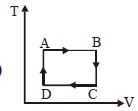
The $P-V$ diagram of a certain process (Carnot cycle) is as shown. The process is also represented as:
- A
- B
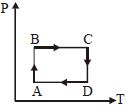
- C
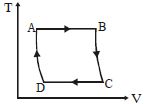
- D
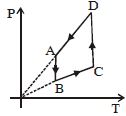
Explore More
Similar Questions
The ratio of the work done, change in internal energy, and heat absorbed when a diatomic gas expands at constant pressure is
Carbon monoxide is taken around the closed cycle $abc$. The process $bc$ is isothermal as shown in the figure. When the temperature of the gas is increased from $300 \ K$ to $1000 \ K$,it absorbs $7000 \ J$ of heat in going from $a$ to $b$. The heat released by the gas during the process $ca$ is ...... $J$.
Difficult
View SolutionOne mole of an ideal diatomic gas expands from volume $V$ to $2V$ isothermally at a temperature $27^{\circ} C$ and does $W$ joule of work. If the gas undergoes the same magnitude of expansion adiabatically from $27^{\circ} C$ doing the same amount of work $W$, then its final temperature will be (close to) . . . . . . ${ }^{\circ} C$.
$A$ monatomic gas at a pressure $P$, having a volume $V$, expands isothermally to a volume $2V$ and then adiabatically to a volume $16V$. The final pressure of the gas is (Take $\gamma = 5/3$)
MediumAIPMT 2014
View Solution$A$ monoatomic gas at pressure $P$ having volume $V$ expands isothermally to a volume $2V$ and then adiabatically to a volume $16V$. The final pressure of the gas is $\left(\gamma = \frac{5}{3}\right)$.
Vedclass Products
For Students
Vedclass Test Series
Mock tests in real JEE/NEET style with performance analysis. 5-day free trial.
Start Free TrialFor Teachers
Exam Paper Generator
Generate Set A/B/C/D exam papers from 7.5L+ questions in 2 minutes. 3 chapters free.
Try FreeFor Institutes
Online Exam Module
Live online exams with unlimited students, 360° analytics & white-label branding.
See Demo