
Class 12PhysicsDual Nature of Radiation and MatterPhotoelectric Effect by Lenard and it's Observations
MediumThe anode voltage of a photocell is kept fixed. The frequency of the light falling on the cathode is gradually increased. Then the correct graph which shows the variation of photo current $I$ with the frequency $\nu$ of incident light is
- A
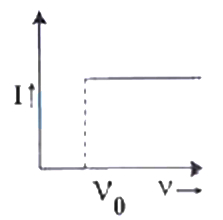
- B
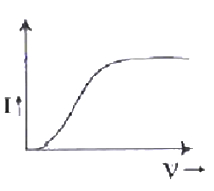
- C
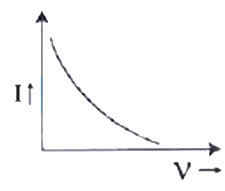
- D
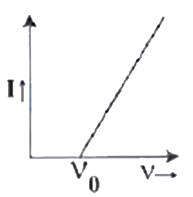
Explore More
Similar Questions
The work functions of Caesium $(Cs)$, Potassium $(K)$, and Sodium $(Na)$ are $2.14 \ eV$, $2.30 \ eV$, and $2.75 \ eV$ respectively. If incident electromagnetic radiation has an incident energy of $2.41 \ eV$, which of these photosensitive surfaces may emit photoelectrons?
The curve between the work function of a metal $(\phi_o)$ and its temperature $(T)$ will be:
Medium
View SolutionPhotoelectrons from a metal do not come out with the same energy. The most appropriate explanation is:
Easy
View SolutionThe figure represents the graph of photoelectric current $I$ versus applied voltage $(V)$. The maximum kinetic energy of the emitted photoelectrons is
Easy
View SolutionTwo metallic plates $A$ and $B$,each of area $5 \times 10^{-4} \, m^2$,are placed parallel to each other at a separation of $1 \, cm$. Plate $B$ carries a positive charge of $33.7 \, pC$. $A$ monochromatic beam of light,with photons of energy $5 \, eV$ each,starts falling on plate $A$ at $t = 0$,so that $10^{16}$ photons fall on it per square meter per second. Assume that one photoelectron is emitted for every $10^6$ incident photons. Also assume that all the emitted photoelectrons are collected by plate $B$ and the work function of plate $A$ remains constant at $2 \, eV$. The electric field between the plates at the end of $10 \, seconds$ is:
Difficult
View SolutionVedclass Products
For Students
Vedclass Test Series
Mock tests in real JEE/NEET style with performance analysis. 5-day free trial.
Start Free TrialFor Teachers
Exam Paper Generator
Generate Set A/B/C/D exam papers from 7.5L+ questions in 2 minutes. 3 chapters free.
Try FreeFor Institutes
Online Exam Module
Live online exams with unlimited students, 360° analytics & white-label branding.
See Demo