
Medium
The anode voltage of a photocell is kept fixed. The wavelength $\lambda$ of the light falling on the cathode is gradually changed. The plate current $I$ of the photocell varies as follows:
- A
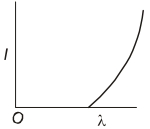
- B
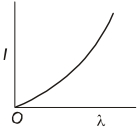
- C
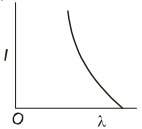
- D
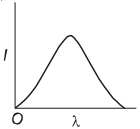
Explore More
Similar Questions
Two parallel discs are connected by a rigid rod of length $L=0.5 \,m$ centrally. Each disc has a slit oppositely placed as shown in the figure. $A$ beam of neutral atoms is incident on one of the discs axially at different velocities $v$,while the system is rotated at an angular speed of $600 \,rev/s$,so that atoms only with a specific velocity emerge at the other end. Calculate the two largest speeds (in $m/s$) of the atoms that will emerge at the other end.
Consider the following statements: $(1)$ Both wave and particle nature are required for a complete understanding of light. $(2)$ Light cannot exhibit both wave and particle nature simultaneously in a single experiment.
Medium
View SolutionThe de Broglie wavelength of a particle moving with a speed of $0.8 c$ is equal to the wavelength of a photon. If $c$ is the speed of light in vacuum, the ratio of the energy of the photon to the kinetic energy of the particle is:
What phenomena of light can be explained on the basis of particle theory and wave theory of light?
Medium
View SolutionThe anode voltage of a photocell is kept constant. The wavelength of the light incident on the cathode is changed gradually. Which of the following graphs represents the variation of the photoelectric current $(I)$ with the wavelength $(\lambda)$?
Medium
View SolutionVedclass Products
For Students
Vedclass Test Series
Mock tests in real JEE/NEET style with performance analysis. 5-day free trial.
Start Free TrialFor Teachers
Exam Paper Generator
Generate Set A/B/C/D exam papers from 7.5L+ questions in 2 minutes. 3 chapters free.
Try FreeFor Institutes
Online Exam Module
Live online exams with unlimited students, 360° analytics & white-label branding.
See Demo