
Medium
The anode voltage of a photocell is kept fixed. The wavelength $\lambda$ of the light falling on the cathode is gradually changed. The plate current $I$ of the photocell varies as follows:
- A
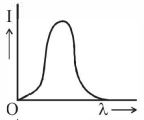
- B
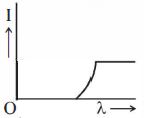
- C
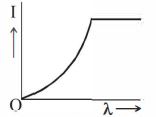
- D
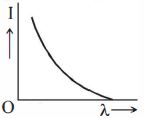
Explore More
Similar Questions
Unification of weak and electromagnetic interactions was done by
Answer the following questions:
$(a)$ Quarks inside protons and neutrons are thought to carry fractional charges $[(+2/3)e, (-1/3)e]$. Why do they not show up in Millikan's oil-drop experiment?
$(b)$ What is so special about the combination $e/m$? Why do we not simply talk of $e$ and $m$ separately?
$(c)$ Why should gases be insulators at ordinary pressures and start conducting at very low pressures?
$(d)$ Every metal has a definite work function. Why do all photoelectrons not come out with the same energy if incident radiation is monochromatic? Why is there an energy distribution of photoelectrons?
$(e)$ The energy and momentum of an electron are related to the frequency and wavelength of the associated matter wave by the relations:
$E = h\nu, p = \frac{h}{\lambda}$
But while the value of $\lambda$ is physically significant,the value of $\nu$ (and therefore,the value of the phase speed $\nu\lambda$) has no physical significance. Why?
Medium
View SolutionIn the photoelectric effect:
$A.$ The photocurrent is proportional to the intensity of the incident radiation.
$B.$ The maximum kinetic energy with which photoelectrons are emitted depends on the intensity of incident light.
$C.$ The maximum kinetic energy with which photoelectrons are emitted depends on the frequency of incident light.
$D.$ The emission of photoelectrons requires a minimum threshold intensity of incident radiation.
$E.$ The maximum kinetic energy of the photoelectrons is independent of the frequency of the incident light.
Choose the correct answer from the options given below:
Match the following columns:
Column-$I$ Column-$II$ $A$. Hallwachs $\&$ Lenard $P$. Transformers $B$. Franck-Hertz $Q$. Microwave $C$. Klystron valve $R$. Quantization of energy levels $D$. Nicola Tesla $S$. Photoelectric effect
| Column-$I$ | Column-$II$ |
|---|---|
| $A$. Hallwachs $\&$ Lenard | $P$. Transformers |
| $B$. Franck-Hertz | $Q$. Microwave |
| $C$. Klystron valve | $R$. Quantization of energy levels |
| $D$. Nicola Tesla | $S$. Photoelectric effect |
Medium
View SolutionMatch List $I$ with List $II$:
List $I$ List $II$ $A$. Planck's constant $(h)$ $I$. $[M^1 L^2 T^{-2}]$ $B$. Stopping potential $(V_s)$ $II$. $[M^1 L^1 T^{-1}]$ $C$. Work function $(\phi)$ $III$. $[M^1 L^2 T^{-1}]$ $D$. Momentum $(p)$ $IV$. $[M^1 L^2 T^{-3} A^{-1}]$
| List $I$ | List $II$ |
|---|---|
| $A$. Planck's constant $(h)$ | $I$. $[M^1 L^2 T^{-2}]$ |
| $B$. Stopping potential $(V_s)$ | $II$. $[M^1 L^1 T^{-1}]$ |
| $C$. Work function $(\phi)$ | $III$. $[M^1 L^2 T^{-1}]$ |
| $D$. Momentum $(p)$ | $IV$. $[M^1 L^2 T^{-3} A^{-1}]$ |
Vedclass Products
For Students
Vedclass Test Series
Mock tests in real JEE/NEET style with performance analysis. 5-day free trial.
Start Free TrialFor Teachers
Exam Paper Generator
Generate Set A/B/C/D exam papers from 7.5L+ questions in 2 minutes. 3 chapters free.
Try FreeFor Institutes
Online Exam Module
Live online exams with unlimited students, 360° analytics & white-label branding.
See Demo